Click Here to View This Page on Production Frontend
Click Here to Export Node Content
Click Here to View Printer-Friendly Version (Raw Backend)
Note: front-end display has links to styled print versions.
Content Node ID: 433510
Both the air transport and business aviation sectors are having to assess the possible impact of a Middle East conflict about to enter a fourth week with no clear end in sight. The soaring cost of fuel has emerged as a dominant consideration alongside ongoing airspace and airport closures that have severely constrained traffic in and out of the Gulf states.
Scheduled airlines are bracing for what Sheila Kahyaoglu, managing director at investment bank Jefferies, described as “demand destruction” during a webinar on Friday organized by JetNet. In her view, business aviation and its high-net-worth customers are more insulated from the crisis, but the industry is still having to contend with soaring fuel prices, with almost a third of jet fuel for the European market alone coming from the Gulf.
Data released by WingX this week shows declining levels of business aviation flight activity in the Middle East; many aircraft have been moved out of the warzone. Despite some involvement in the scramble to evacuate stranded passengers from the Gulf, private charter activity has been severely curtailed, with operators in the region seeing a year-over-year flight decline of around 70%.
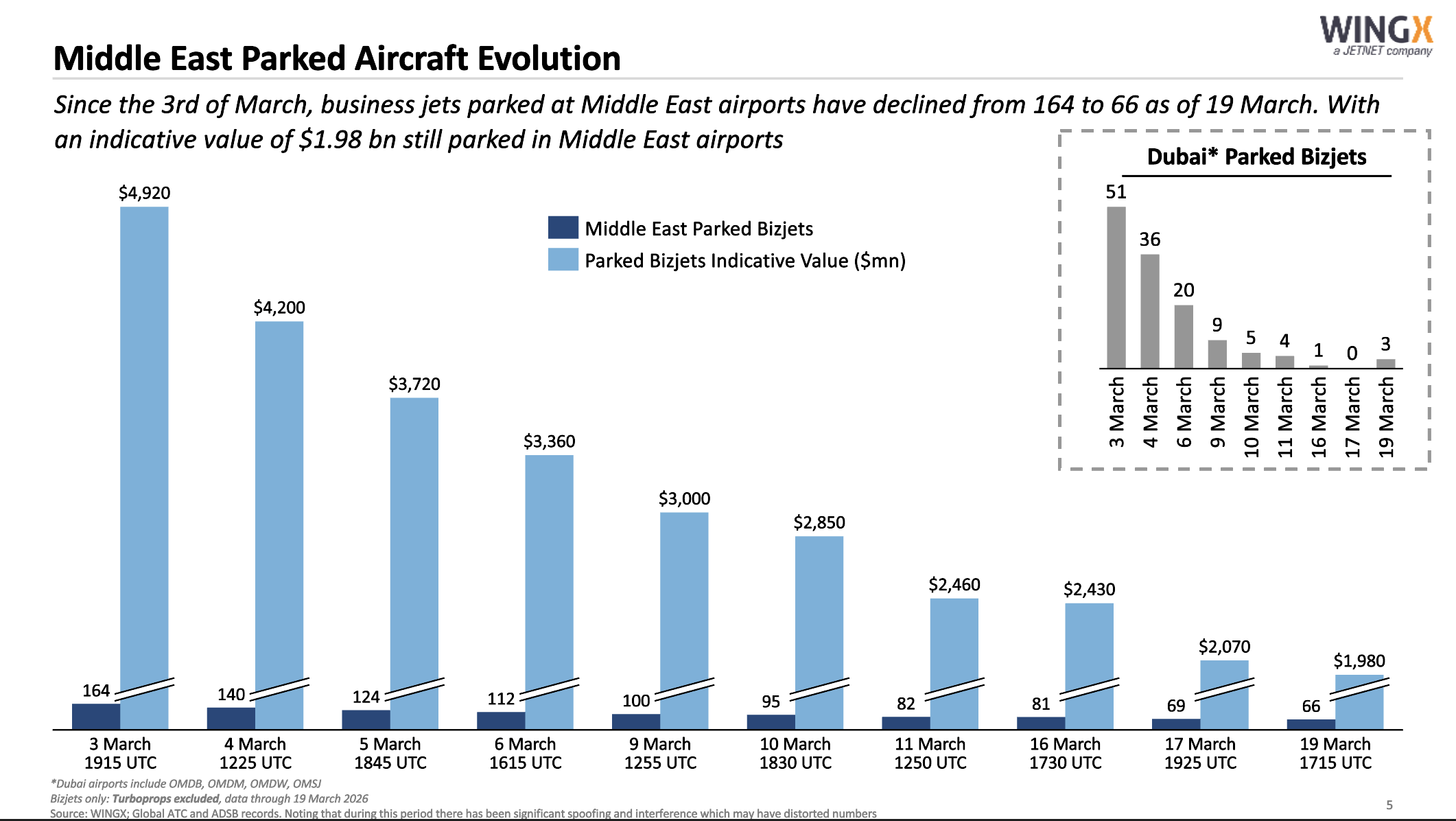
WingX managing director Richard Koe showed data illustrating a sharp decline in the number of business jets parked at Middle East airports. The total has dipped from 164 on March 3 to 66 on March 17. However, those still in the conflict zone have a combined value of $1.98 billion.
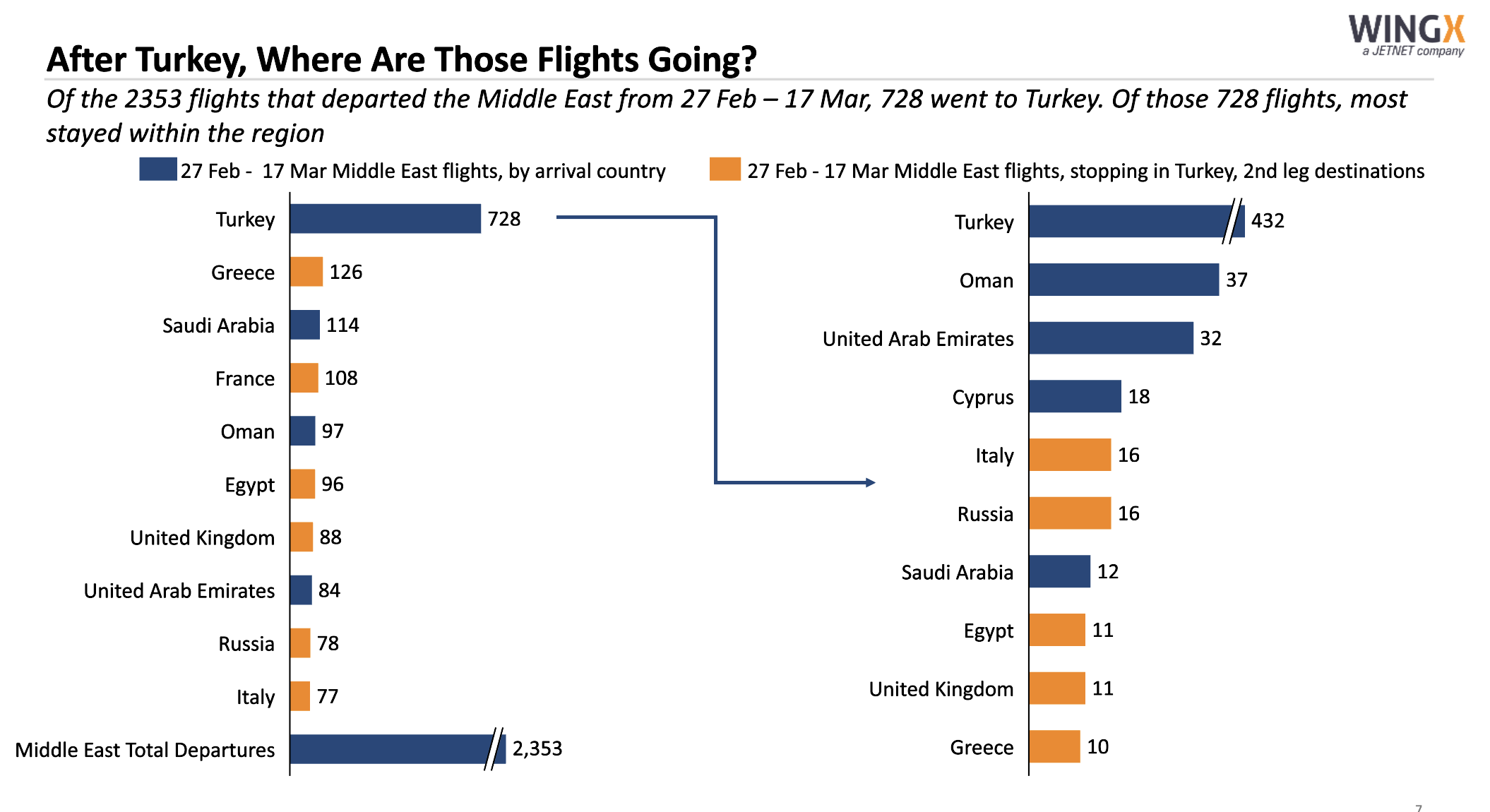
The company’s tracking of flights over the past three weeks shows a clear migration pattern to cities including Istanbul and Ankara in Turkey, and Oman’s capital, Muscat. Many aircraft subsequently moved further afield to locations including Italy, Russia, Egypt, the UK, and Greece.
Bernhard Fragner, CEO and founder of Austria-based operator GlobeAir, acknowledged that the role of business jets in evacuations from the Gulf has been exaggerated, in part by inaccurate social media posts giving the impression of easy access to private flights. He told the webinar that security risks remain very real, including for flights to and from Turkey, which WingX data shows has been a popular stopping point for aircraft moving out of the region.
“No one now feels comfortable in the Gulf, and people are now making up their minds where else they might go [on charter flights],” Fragner commented. “We are seeing increased requests for destinations in Europe, especially for Easter.”
With between 15% to 20% of charter flight costs based on fuel, rising prices of jet-A are set to have an impact. According to Fragner, charter operators face a “very dynamic” situation in the coming weeks, and he feels that they will not feel able to pass along all of this extra cost to customers.
Middle East Boom Interrupted
Until the war broke out on February 28, the Middle East had been a key growth market for business aviation. Saudi Arabia has opened up access to foreign companies, including charter operators such as VistaJet, Flexjet, and AirX. The region has also seen a flurry of investment in new infrastructure, such as private terminals and FBOs planned by companies including Universal Aviation.
According to Alasdair Whyte, editor of Corporate Jet Investor, business aviation hotspots like Dubai will bounce back if the conflict only lasts a few more weeks and does not trigger a major financial crisis. He also argued that most of the big aircraft operators are not very exposed to the Middle East market and can mitigate risk by relocating jets to other markets.
Reflecting on the commercial aviation sector, Jefferies analysts are trying to assess just how big a dent Middle East disruption could inflict on the global industry. “There could be global demand destruction and the Middle East had been expected to grow at 6% this year but could go down to zero, and we hope that global [traffic] growth only goes from 5% to 4% and not down to 1% or 2% as it did in 2020 [during the Covid pandemic],” Kahyaoglu commented.
Business aviation service providers are also bracing for a downturn they hope will be confined to the immediate conflict region. Cat Buchanan, business development director of Stack Aero—which provides a business operations system for multiple companies across the sector—told AIN that the Middle East had been “growing exponentially” until the war broke out, but its maturation process was interrupted.
In the short term, Buchanan has seen “huge crisis-driven demand” for charter flights with greatly inflated prices up to 200% above normal rates. Her own husband was able to get home from Abu Dhabi on an evacuation flight, having been trapped there during a work trip when the conflict started.
Julie Black, head of business aviation with charter broker Hunt & Palmer, has seen a similar short-term spike in demand, but remains concerned about the longer-term impact of factors such as high fuel costs. “There has been some shocking profiteering with charter flights from the Middle East to Europe priced as high as $400,000,” she told AIN.
Black also expressed concern about some illegal or “gray” charter flight activity in which passengers eager to evacuate were persuaded to pay to travel on aircraft operated under Part 135 commercial rules with significant associated risks around insurance and liability. “These situations always seem to bring out the best and the worst in people,” she concluded.