Click Here to View This Page on Production Frontend
Click Here to Export Node Content
Click Here to View Printer-Friendly Version (Raw Backend)
Note: front-end display has links to styled print versions.
Content Node ID: 434301
Total carbon dioxide (CO2) emissions from global flight activity have continued to increase, despite progress by the airline sector in cutting “carbon intensity” on a revenue tonne kilometer (RTK) basis, according to new analysis by the IBA consultancy. A report issued on Monday showed that CO2 emissions in 2025 were higher than pre-Covid levels at 960 million tonnes, representing a 2.7% increase over 2019 due to traffic growth.
The overall increase occurred even though commercial carriers reduced carbon intensity from 860 grams per RTK in 2018 to 690 grams, representing a 20% improvement. IBA’s analysts said that the contrast between the two sets of figures highlights the challenges the industry faces in meeting its target of net-zero emissions in 2050.
“While airlines are transporting passengers and cargo more efficiently than ever before, the growth in overall flight activity is continuing to offset many of these operational gains,” IBA reported. “The data shows that global CO2 intensity has followed a gradual downward trend since 2018, while total emissions have steadily recovered and [have] now surpassed pre-pandemic levels.”
The IBA report also tracked regional variations in carbon emissions. For instance, in North America, emissions intensity dropped from 920 grams in 2018 to 760 grams in 2025, but total emissions increased from 50 million tonnes to almost 60 million tonnes.
Over the same period, operators in the Asia-Pacific region cut carbon intensity from 860 grams per RTK to 700 grams but still saw total emissions grow to almost 80 million tonnes by the end of last year. Similarly, in the Middle East, total emissions grew from 22 to 27 million tonnes despite improvements in operational efficiency.
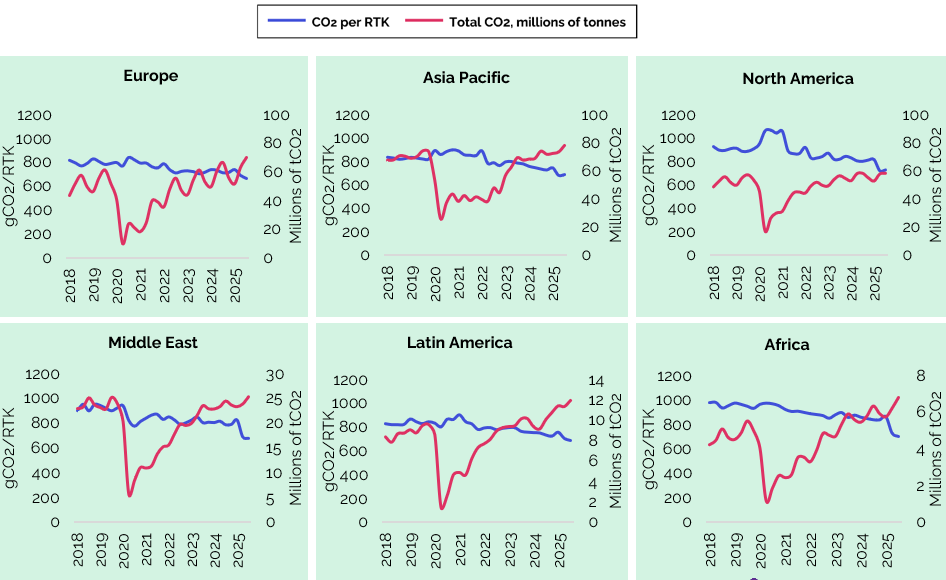
By contrast, Europe had relatively moderate emissions growth while also cutting carbon intensity. Africa and Latin America both recorded improvements in efficiency even as total emissions increased.
“Improving operational efficiency alone is no longer sufficient if absolute emissions continue to rise alongside growth in passenger and cargo demand,” the IBA report concluded. “Future progress towards Net Zero 2050 will increasingly depend on accelerating sustainable aviation fuel adoption, fleet renewal and carbon removal strategies, alongside continued efficiency gains.”