Click Here to View This Page on Production Frontend
Click Here to Export Node Content
Click Here to View Printer-Friendly Version (Raw Backend)
Note: front-end display has links to styled print versions.
Content Node ID: 395021
“No one knows a Bombardier aircraft better than we do,” says Bill Molloy, vice president of Bombardier Business Aircraft Aftermarket Sales. Molloy is on a mission to bring as many aircraft as possible back “home” to Bombardier service centers.
“When aircraft come home to one of our nine service centers around the world, we can control the quality of workmanship, ensure the customer receives the best parts, and create a stronger bond with that customer, who will likely be flying that aircraft for many years to come,” says Molloy.
Controlling the quality of maintenance and parts contributes to what Molloy and others at Bombardier call “the OEM advantage.” It starts with the best-trained technicians, access to airframe and systems engineering and the best availability of parts throughout the network.
Technical Training Around the Globe
“When technicians come to train with us in Montreal, they benefit from hands-on experience with the aircraft,” says Andy Nureddin, vice president of Customer Support for Bombardier Business Aircraft. “They don’t just see a PowerPoint presentation demonstrating a particular part. They actually see it, feel it, and they know exactly where that part fits on the aircraft. That’s one of the unique advantages of being an OEM training provider.”
With more than 30 years in the training field, Bombardier offers a variety of maintenance and flight-operations courses on its Learjet, Challenger, and Global aircraft series. The courses were created by award-winning instructional design teams and are conducted by instructors with an average of 12 years of experience who work in engineering, production or flight operations. Many of these courses can be customized to target specific aircraft features or maintenance areas, cover regulatory requirements for one of more than a dozen agencies, or fit other specific customer needs.
“Some customers ask us to craft a specific technical course based on the training needs analysis that they conduct within their organization,” says Nureddin. “One example is providing cold weather operations training for customers in certain parts of the world. Other organizations may decide that their technicians need a refresher on a particular area or training on a recent regulatory change that requires enhanced awareness for compliance.”
Bombardier’s global reach and scale provides another OEM advantage: the ability to offer training sessions at its service centers around the globe.
“One of the challenges with technical training in its classic format is that the employee is taken out of productivity for several weeks,” says Nureddin. “For customers outside of North America especially, we found that providing courses at the service centers when the aircraft is already down for maintenance works best for all those involved. Often the technicians can supervise their aircraft being worked on while also attending training.”
Innovative and Evolving Pilot Training
Another OEM advantage is being able to rapidly develop and incorporate training on new features into the curriculum.
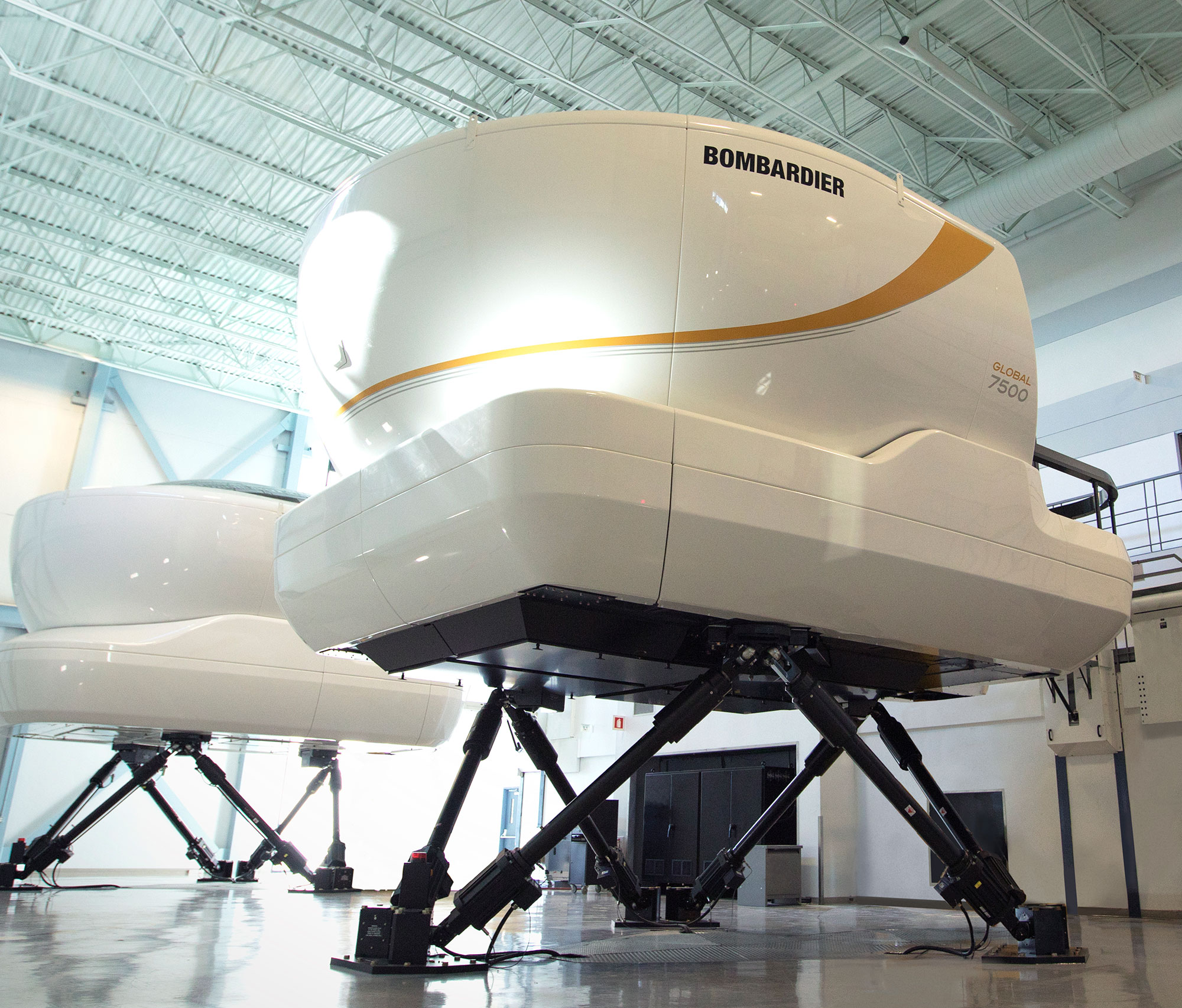
“Enhancements to our aircraft are closely and immediately integrated into the training curriculum,” says Nureddin. “Our training personnel work closely with the engineers, often allowing training to be developed alongside the new product and ready when the product is launched. For example, on Global series aircraft, we have developed a three-day general familiarization course for the Global 7500 aircraft.” Nureddin also cites another example of incorporating the certified Global 6000 steep-approach capability on the full-flight simulators at Bombardier’s two Aircraft Training Centers in Montreal and Dallas.
Innovation has been a key to success at Bombardier, and its training is no different. From being one of the first OEMs to offer computer-based training back in the 1990s, to experimenting with virtual reality today, such as virtual flight decks that allow students to practice piloting on all new aircraft programs, Bombardier continually finds new ways to offer training solutions that fit each customer’s needs. Training is also a key component when launching and delivering new aircraft at Bombardier, which further denotes the quality and safety of Bombardier’s products at entry-into-service.
“In addition to 12 fixed-based and full-flight simulators, our training centers use a variety of procedure trainers, flight management system [FMS] trainers, and task training devices to enhance training,” explains Nureddin. “Most courses use a combination of classroom, computer-led and self-paced study. For Challenger 605 recurrent pilot training, for example, 40 percent of the work can be done online at home, followed by instructor-led briefings before the simulator check ride.”
Safety is always a major consideration in aviation training, and here, Bombardier maintains another OEM advantage. Not only are regulatory changes immediately incorporated into training courses, but industry trends highlighted at Bombardier’s annual Safety Standdown are incorporated as well. Typically held each year in Wichita, Kansas, in late October, Safety Standdown is open to all pilots, crewmembers, maintenance technicians and managers, regardless of aircraft or manufacturer, and features a variety of industry experts discussing the latest research and discoveries on the hottest aviation safety trends.
“A few years ago, upset prevention and recovery training was identified as an industry need, so we built that right into our courseware,” says Nureddin. “Before that, controlled flight into terrain was an emphasis. Anything that is topical to the industry at large, we weave into the fabric of our courseware.”
Bombardier-Backed Parts and Services
The “OEM advantage” doesn’t stop with training. Parts installed at a Bombardier service center or ordered from Bombardier for installation elsewhere are genuine Bombardier-approved parts in accordance with best practices.
“We approve only the highest-quality parts suppliers, and we audit them regularly,” says Molloy. “In addition, we were the first OEM to institute an accident and incident parts policy that prohibits the use of any part involved in an accident or incident. We are leading the industry with this practice and it offers our customers greater peace of mind.”
In addition to delivering the highest quality, Bombardier strives to provide the best value for its parts, including an “on-the-spot price-matching” policy. On top of the price-match policy, Bombardier offers a two-year warranty on parts ordered from the company.
“If customers tell us that they can get a part cheaper from a different supplier, we’ll take the information, match the price, and verify later. Customers want to buy from us and it’s a process that builds trust between us and our customers,” says Molloy.
Customers with an aircraft-on-ground (AOG) can also benefit from another OEM advantage: Bombardier’s ability to stock parts at key locations around the world and use its dedicated Mobile Response Team aircraft, line maintenance stations and/or Mobile Response Team vehicles to rapidly deliver parts and personnel to the aircraft.
“We provide a full range of AOG services,” says Molloy. “An AOG customer may need a part at 2:00 in the morning. They can quickly check our online parts ordering database, which provides instant information on prices, availability and location. The order is transacted immediately through our system, and our 24/7 Customer Response Center jumps into action to assist.”
Bombardier knows customers have several options when choosing a maintenance center. In addition to its own service centers, Bombardier works closely with a network of third-party Authorized Service Facilities (ASF) around the world. Thoroughly vetted and audited by Bombardier, the ASFs maintain a high level of standards set by the OEM for technician training and parts quality.
A further example of how Bombardier is providing the best OEM parts solution is its recent relationship with Safran. As a world leader in landing-gear systems, Safran is now the exclusive supplier for landing-gear overhaul on the Challenger and Global aircraft series that are enrolled in Bombardier’s Smart Services programs.
To amortize the cost of high-value parts and services like landing-gear overhauls, many customers enroll their aircraft in one of Bombardier’s Smart Services programs. In essence, these programs offer utmost flexibility for customers to cover the cost of aircraft system component replacements through a tailored cost-per-flight-hour coverage.
“The Smart Services programs provide our customers more predictability and control over their maintenance budgets,” says Molloy. “Since we’ve added complete coverage of the landing-gear overhaul as an available option to the program, customers are really starting to see a benefit in paying the monthly fee and not getting hit with a large bill when their landing gear overhaul is due.”