Click Here to View This Page on Production Frontend
Click Here to Export Node Content
Click Here to View Printer-Friendly Version (Raw Backend)
Note: front-end display has links to styled print versions.
Content Node ID: 429724
On Saturday, Beechcraft King Air B200 N479BR landed at Colorado’s Rocky Mountain Metropolitan Airport (KBJC) after the aircraft’s Garmin Autoland system was activated. This marks the first in-service activation of an Autoland-equipped airplane, although neither of the two pilots on board was incapacitated.
The King Air, managed by Buffalo River Aviation, was being operated under Part 91 on a repositioning flight from Aspen, Colorado, with only the two pilots on board. According to Buffalo River Aviation, “Climbing through 23,000 feet msl, the aircraft experienced a rapid, uncommanded loss of pressurization. As per standard procedures, the two pilots immediately put on their oxygen masks. The aircraft, equipped with Garmin Aviation’s latest Emergency Descent Mode (EDM) and Autoland systems, automatically engaged exactly as designed when the cabin altitude exceeded the prescribed safe levels. The system selected a suitable airport per Garmin criteria (KBJC, Rocky Mountain Metropolitan Airport), navigated to it, and communicated automatically along the way.”
Autoland can be activated by a pilot or passenger pushing a button, or it automatically engages if the pilot doesn’t interact with the aircraft after a certain period of time or in case of loss of pressurization. During the activation, the system automatically broadcasts messages on the 121.5 emergency and local tower or CTAF frequencies, depending on the airport. As the airplane nears the selected airport, Autoland lowers the flaps and landing gear, and after landing, brakes to a stop, then shuts down the engines.
According to corporate pilot Ryan Barstad, who had just departed KBJC to the southwest, he and his copilot heard the Autoland system’s automatic broadcasts on the 121.5-MHz guard frequency.
“It was after we heard it a couple of times that we heard a pilot come on guard with what sounded like could only be a quick-donning oxygen mask, stating that they had lost cabin pressurization,” Barstad told AIN. “He made only a couple callouts, then we didn’t hear from him.”
In a LiveATC recording of KBJC’s tower frequency, the Autoland voice said: “Niner-bravo-romeo, pilot incapacitation, two miles south of kilo-bravo-juliet-charlie, emergency autoland in 19 minutes on Runway three zero right at kilo-bravo-juliet-charlie.” The tower controller is then heard telling a pilot, “We’ve got a nordo [no radio] King Air that’s also experiencing an emergency, so I’m going to have to full stop you on this one [landing].”
After another of the Autoland broadcasts, the controller said: “Currently inbound, computer is estimating be on the ground in a few minutes, and there are autolanding features and they’re expecting them to stop on the runway.” The Autoland broadcasts continued.
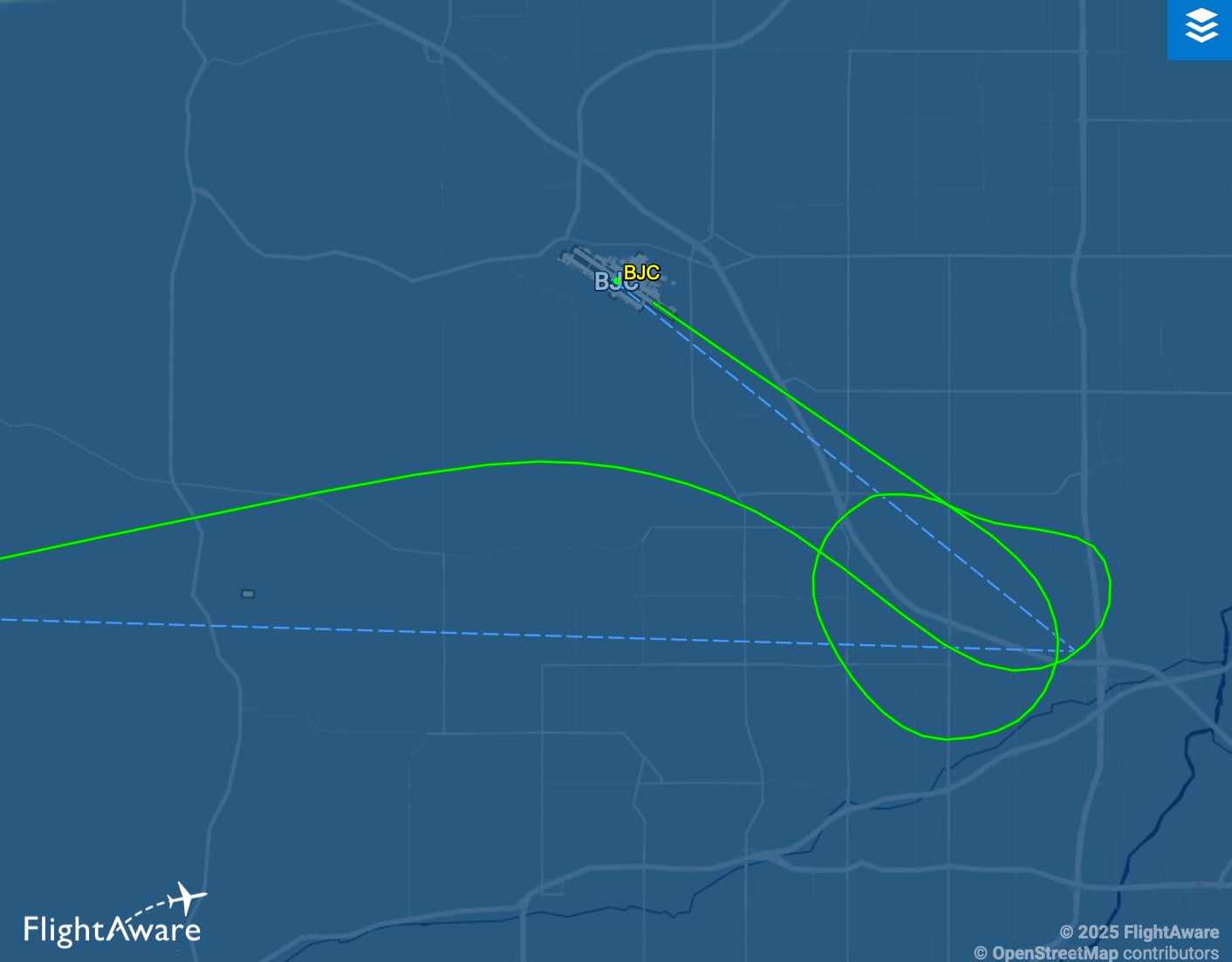
According to the FlightAware track of the flight, the King Air flew a wide circle southeast of KBJC before lining up with Runway 30R. After another automatic broadcast, the tower controller called the King Air and said, “King Air, Metro Tower, if you can hear me, any runway, cleared to land, wind 350 at 6, altimeter 30.00.” When the King Air was two miles from landing, the controller told a pilot that the airport was closed and to hold for landing. “We’re not sure when it’s going to be open,” he said.
N479BR is registered to Gunner Aviation of Fayetteville, Arkansas, and operated by Buffalo River Aviation. The Autoland system, including a Garmin G1000 NXi avionics suite, was installed by Blackhawk Performance Center in Columbia, Missouri, earlier this year, marking the first post-supplemental type certificate Autoland installation for a King Air B200. “Everyone at The Blackhawk Group is incredibly thankful that all parties are safe after initiating the historic maneuver,” the company said. “The safe landing at KBJC confirms that this level of autonomy for the King Air 200 is no longer theoretical, it is operational and proven.”
Buffalo River Aviation added more context to the Autoland activation in a statement from CEO Chris Townsley: “Due to the complexity of the specific situation, including instrument meteorological conditions, mountainous terrain, active icing conditions, unknown reasons for loss of pressure, and the binary (all-or-nothing) function of the Garmin emergency systems; the pilots, exercising conservative judgement under their emergency command authority (FAR 91.3), made the decision to leave the system engaged while monitoring its performance and attempting communications as able within the constraints of the system. While the system performed exactly as expected, the pilots were prepared to resume manual control of the aircraft should the system have malfunctioned in any way.
“Reports of pilot incapacitation are incorrect and result solely from the Garmin emergency system's automated communication and reporting functions. In this case, the crew consciously elected to preserve and use all available tools and minimize additional variables in an unpredictable, emergent situation, prioritizing life and a safe outcome over all other factors, as they are trained to do. The aircraft returned home the following day without incident.
“Buffalo River Aviation is grateful to the pilots for their exceptional judgment and execution of protocols, and to the Rocky Mountain Metropolitan Airport and Denver Center Tracon personnel for their assistance and support during this event.”
Garmin issued a statement over the weekend that said: “Garmin can confirm that an emergency Autoland activation occurred at Rocky Mountain Metropolitan Airport in Broomfield, Colorado. The Autoland took place on Saturday, December 20, resulting in a successful landing. We look forward to sharing additional details at the appropriate time.”
On Sunday, the King Air was flown from KBJC to Wiley Post Airport (KPWA) in Oklahoma City at 11,000 feet.