Click Here to View This Page on Production Frontend
Click Here to Export Node Content
Click Here to View Printer-Friendly Version (Raw Backend)
Note: front-end display has links to styled print versions.
Content Node ID: 433349
Dassault Aviation’s fresh offering at the top end of the business jet market took its bow on Tuesday when the French airfamer rolled out its Falcon 10X model in Bordeaux. The very-large-cabin, ultra-long-range, high-speed aircraft is the second of several prototypes to be built at the group’s Mérignac production line, and one of these will soon be used for the first test flight.
With an eight-passenger range of 7,500 nm, the 10X extends the Falcon family’s intercontinental reach, while also offering Dassault’s widest, tallest cabin to date, alongside its 8X, 6X, and 2000XLS siblings. Its projected top speed will be Mach 0.925, which is somewhat slower than the rival Bombardier Global 8000 model and Gulfstream Aerospace’s G800—with both of these competitors offering greater range than the 10X but smaller cabins.
For Dassault and its partners, the 10X has been an entirely clean-sheet design. The twinjet is powered by a pair of Rolls-Royce Pearl 10X turbofans, delivering more than 18,000 pounds of thrust, and the flight deck features the NeXus avionics suite developed with Honeywell. Michelin is providing its new, lightweight AirX tires, which it said will contribute to reduced fuel burn.
So far, Dassault has built two of the four 10Xs it will use for a type certification campaign it expects to complete in late 2027. The first example will be used for flight testing, with taxi tests expected to begin in Bordeaux very soon. The fully-painted second aircraft was used for the rollout event, and the other two 10Xs will have fully completed cabin interiors and will be used for operational flight trials around the world.
Dassault and partners have already logged around 3,000 ground test hours with various systems and 15,000 hours on test benches. The first Pearl 10X engine run was achieved last December, and Rolls-Royce is now discussing data collected with EASA as it works to certify the powerplant.
Applying Rafale Fighter Performance
Before the rollout event, technical sales manager Philippe Reigner told a press briefing in Paris that the 10X’s composite wing is a key performance differentiator. The wing, which is one of several technological features that Dassault has based on its Rafale fighters, is lighter and with greater “aeroelasticity” to dampen turbulence for improved cabin comfort.
The new model’s horizontal stabilizer has been moved to the top of the tail to optimize high-speed cruise. According to Dassault, the 10X is optimized to cruise at between Mach 0.85 and 0.90 without significantly diminishing the range.
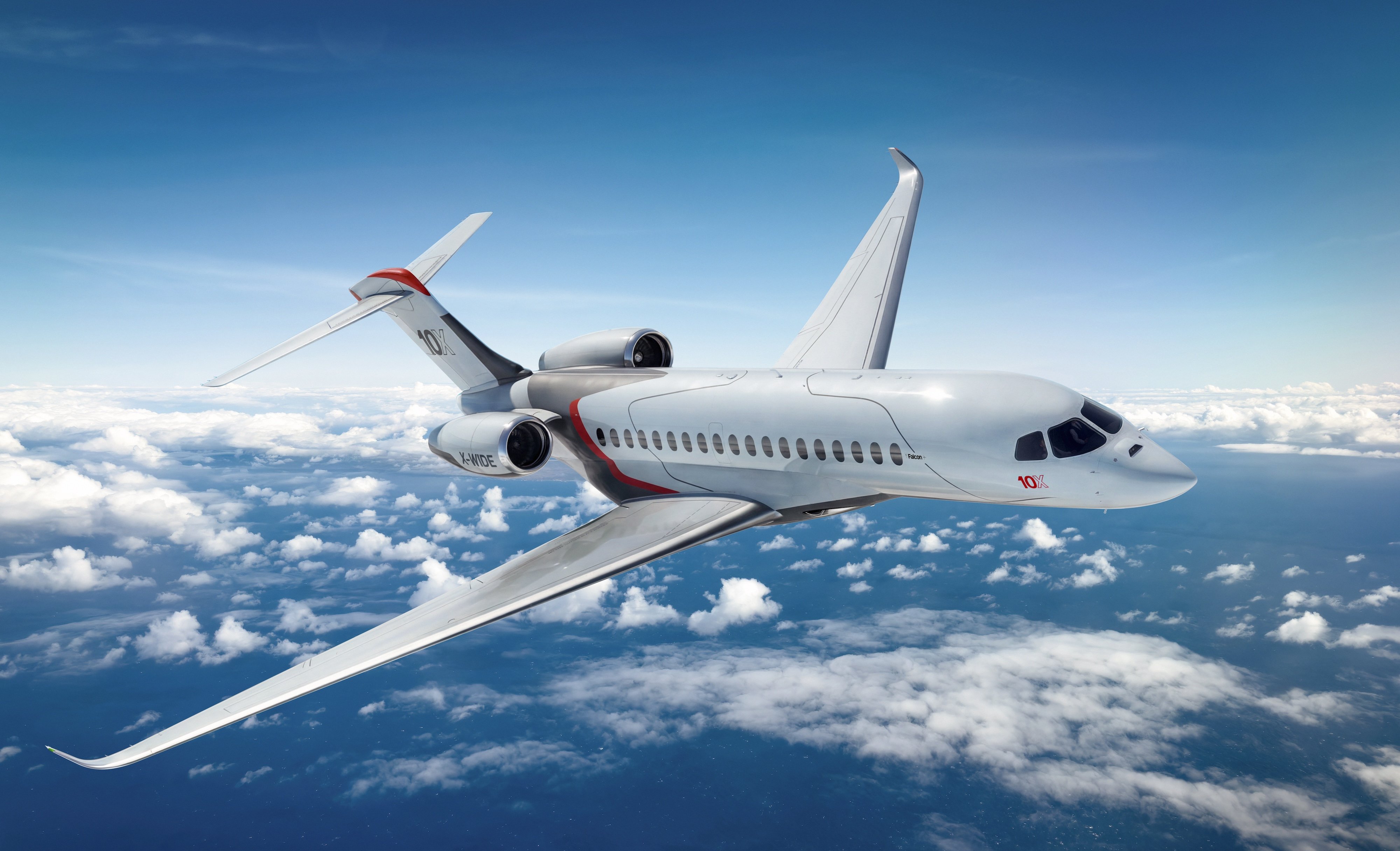
Reigner explained that a high constant sweep angle and low relative thickness have been designed to optimize drag at high Mach. A combination of a progressive chord ratio, leading-edge slats, and a curved trailing edge has avoided a compromise between low and high-speed performance to support short runway operations.
The 10X will have a maximum takeoff weight balanced field length of less than 6,000 feet and a landing distance of less than 2,500 feet. Dassault intends to seek approval for steep approach operations at locations such as London City Airport.
During the briefing, Dassault presented range maps showing the 10X’s globe-girdling range, which includes non-stop flights from New York to Beijing, Punta Arenas in Chile, and Johannesburg in South Africa. Flying from Paris, the new Falcon flagship should be able to reach everywhere without a fuel stop apart from Australasia, while from São Paulo in Brazil, the range covers all of the Americas and as far east as Dubai.
Cabin Options Exploit Extra Space
The new Falcon’s cabin interior, with four lounge zones plus a galley and bathroom, is 9 ft 1 in wide and 6 ft 8 in tall. These dimensions compare, respectively, with 8 ft 2 in and 6 ft 3 in for the G800, and 8 ft and 6 ft 2 in for the Global 8000.
Within the 10X’s available cabin volume of 2,780 cu ft, Dassault offers four standard interior configurations. In addition to the standard Ultimate Edition, customers can opt for the Executive Signature with an ultra-wide conference area; the three-lounge Grand Residence featuring a master suite with a large bathroom and an ultra-large dining area; or the Serenity Suite with a bedroom, a private home cinema, and a large bathroom.
With a cabin altitude of 3,000 feet at FL410, the 10X cabin will use new-generation filters to deliver cleaner air by controlling ozone and volatile organic compound levels. Light levels will be maximized through 38 windows, delivering around 30% more natural light than previous Falcons.
Dassault has tapped its quiet cabin technology from the 8X model to reduce noise levels even at the 10X’s higher speeds. The manufacturer also aims to reduce aerodynamic noise with a new flat roof shape above the cockpit. New covers for the fuselage fairings minimize vortex drag. Reigner told reporters the profile of this part of the airframe “is like a Coke bottle.”
Lightening the Pilots' Load
According to experimental test pilot Antoine Doussaud, the NeXus flight deck will boost the crew’s ability to anticipate changes in flight conditions with a lighter workload. He said the technology, which builds on the EASy avionics suites used for earlier Falcons, will also improve situational awareness for pilots.
The flight deck architecture is built around four main displays arranged in a T-shape, with four secondary displays at the sides and on the pedestal. Also new are a pair of “smart scratch touch pads” developed by Honeywell engineers in the Czech Republic to simplify data entry.
NeXus also features what Dassault refers to as “Open World” capability, which means it can accommodate applications such as weather and maintenance data. This can also be used to provide pilots with information to support special missions roles.
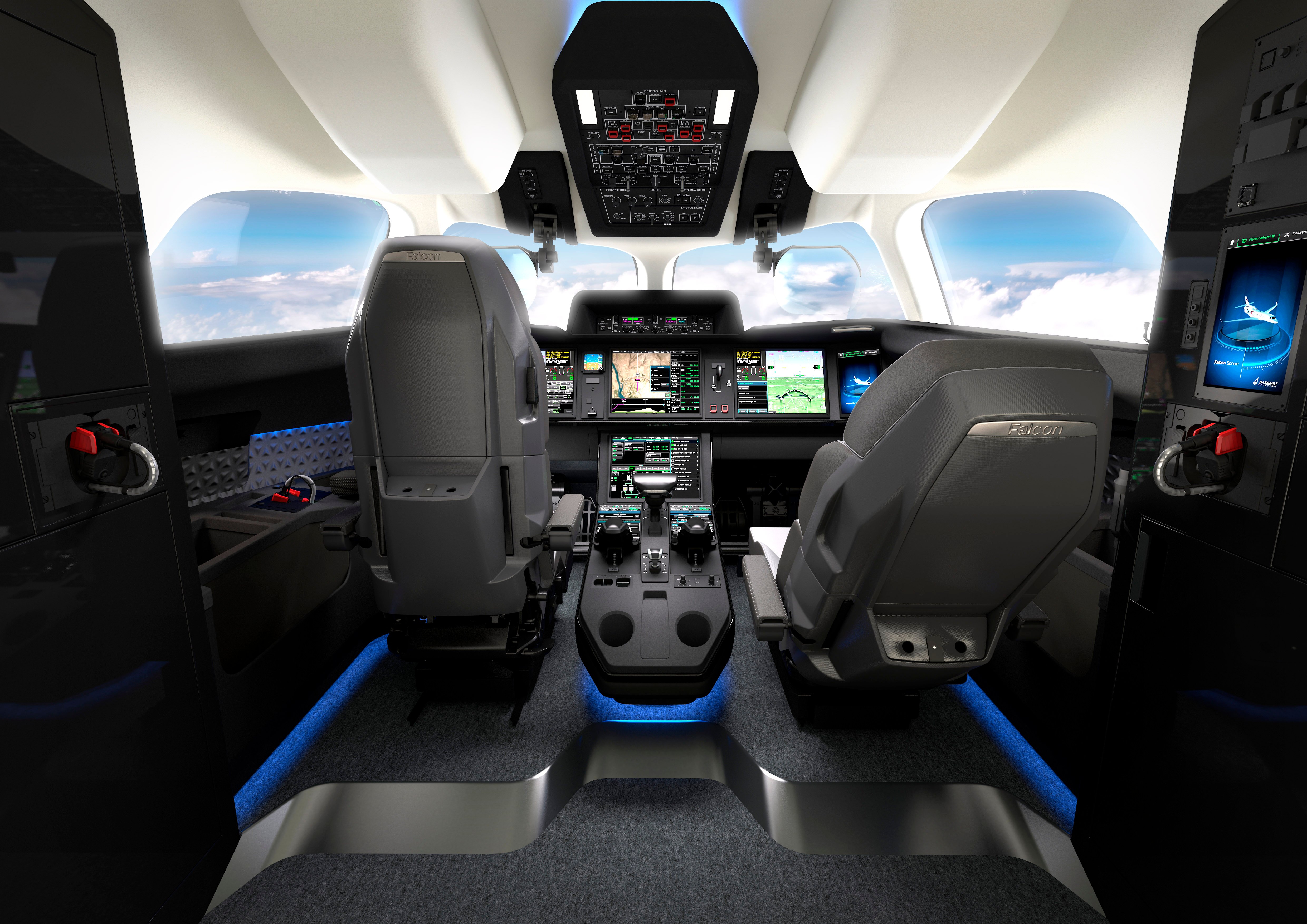
Other features incorporated from existing Falcons include the FalconEye dual head-up display, and there is a single throttle to manage both engines. “If that sounds too simple, that’s exactly the point,” Doussaud commented. “Pilots no longer have to adjust engine parameters: they just control the amount of power required, whatever the number of engines available.”
NeXus incorporates multiple protection modes, including what Dassault says are first for passenger-carrying aircraft: autopilot and autothrottle systems that engage automatically when an emergency situation is detected. “If the pilots fail to react, the airplane will take over and protect everyone on board,” Doussaud explained.
The full array of safety modes also covers ice protection, runway overrun alerts, terrain and traffic avoidance, as well as automatic windshear protection and an emergency descent mode that deploys in case of depressurization. Other features migrated from the Rafale fighters include automatic terrain avoidance and upset recovery capability.
Rolls-Royce's First Falcon
Philipp Zeller, Rolls-Royce’s senior vice president for the Pearl 10X program, said the engine maker is delighted to be powering its first Falcon aircraft. He told the media briefing that 3,500 test hours on the turbofan, including 25 test flights on a Boeing 747 covering 36,000 nm, give the OEM confidence it can deliver on its claim to provide full maturity from the Falcon 10X’s entry into service.
The powerplant features a 10-stage, high-pressure compressor and six stages of blisked fans, plus a two-stage shroudless high-pressure turbine, a four-stage low-pressure turbine, and slimline nacelles. Rolls-Royce is using additive layer manufacturing for the combustor with improved cooling hole performance to reduce temperatures and increase durability.
The engine maker has established a new facility next to Dassault’s Mérignac assembly line to support Falcon 10X production. Zeller said it has already finished 10 engines to support the flight test campaign.
Dassault Aviation’s fresh offering at the top end of the business jet market took its bow on March 10, when the French airfamer rolled out its Falcon 10X model in Bordeaux. The very large cabin, ultra-long-range, high-speed aircraft is the second of several prototypes to be built at the group’s Mérignac production line, and one of these will soon be used for the first test flight.
With an eight-passenger range of 7,500 nm, the 10X extends the Falcon family’s intercontinental reach, while also offering Dassault’s widest, tallest cabin to date, alongside its 8X, 6X, and 2000XLS siblings. Its projected top speed will be Mach 0.925, which is somewhat slower than the rival Bombardier Global 8000 model and Gulfstream Aerospace’s G800—with both of these competitors offering greater range than the 10X but smaller cabins.
For Dassault and its partners, the 10X has been an entirely clean-sheet design. The twinjet is powered by a pair of Rolls-Royce Pearl 10X turbofans, delivering more than 18,000 pounds of thrust, and the flight deck features the NeXus avionics suite developed with Honeywell. Michelin is providing its new, lightweight AirX tires, which it said will contribute to reduced fuel burn.
So far, Dassault has built two of the four 10Xs it will use for a type certification campaign it expects to complete in late 2027. The first example will be used for flight testing. The fully-painted second aircraft was used for the rollout event, and the other two 10Xs will have fully completed cabin interiors and will be used for operational flight trials around the world.
Dassault and partners have already logged around 3,000 ground test hours with various systems and 15,000 hours on test benches. The first Pearl 10X engine run was achieved last December, and Rolls-Royce is now discussing data collected with EASA as it works to certify the powerplant.
Before the rollout event, technical sales manager Philippe Reigner told a press briefing in Paris that the 10X’s composite wing is a key performance differentiator. The wing, which is one of several technological features that Dassault has based on its Rafale fighters, is lighter and with greater “aeroelasticity” to dampen turbulence for improved cabin comfort.
The new model’s horizontal stabilizer has been moved to the top of the tail to optimize high-speed cruise. According to Dassault, the 10X is optimized to cruise at between Mach 0.85 and 0.90 without significantly diminishing the range. Reigner explained that a high constant sweep angle and low relative thickness have been designed to optimize drag at high Mach.
The 10X will have a maximum takeoff weight balanced field length of less than 6,000 feet and a landing distance of less than 2,500 feet. Dassault intends to seek approval for steep approach operations at locations such as London City Airport.
During the briefing Dassault presented range maps showing the 10X’s globe-girdling range, which includes non-stop flights from New York to Beijing, Punta Arenas in Chile, and Johannesburg in South Africa.
The new Falcon’s cabin interior, with four lounge zones plus a galley and bathroom, is 9 ft 1 in wide and 6 ft 8 in tall. These dimensions compare, respectively, with 8 ft 2 in and 6 ft 3 in for the G800, and 8 ft and 6 ft 2 in for the Global 8000.
Within the 10X’s available cabin volume of 2,780 cu ft, Dassault offers four standard interior configurations, have a cabin altitude of 3,000 feet at FL410, and light maximized through 38 windows.
According to experimental test pilot Antoine Doussaud, the NeXus flight deck will boost the crew’s ability to anticipate changes in flight conditions with a lighter workload. The technology builds on the EASy avionics suites used for earlier Falcons.
The NeXus flight deck features new safety features including an autopilot and autothrottle that deploy if pilots do not respond to an emergency. Other features the FalconEye dual head-up display.