Click Here to View This Page on Production Frontend
Click Here to Export Node Content
Click Here to View Printer-Friendly Version (Raw Backend)
Note: front-end display has links to styled print versions.
Content Node ID: 433833
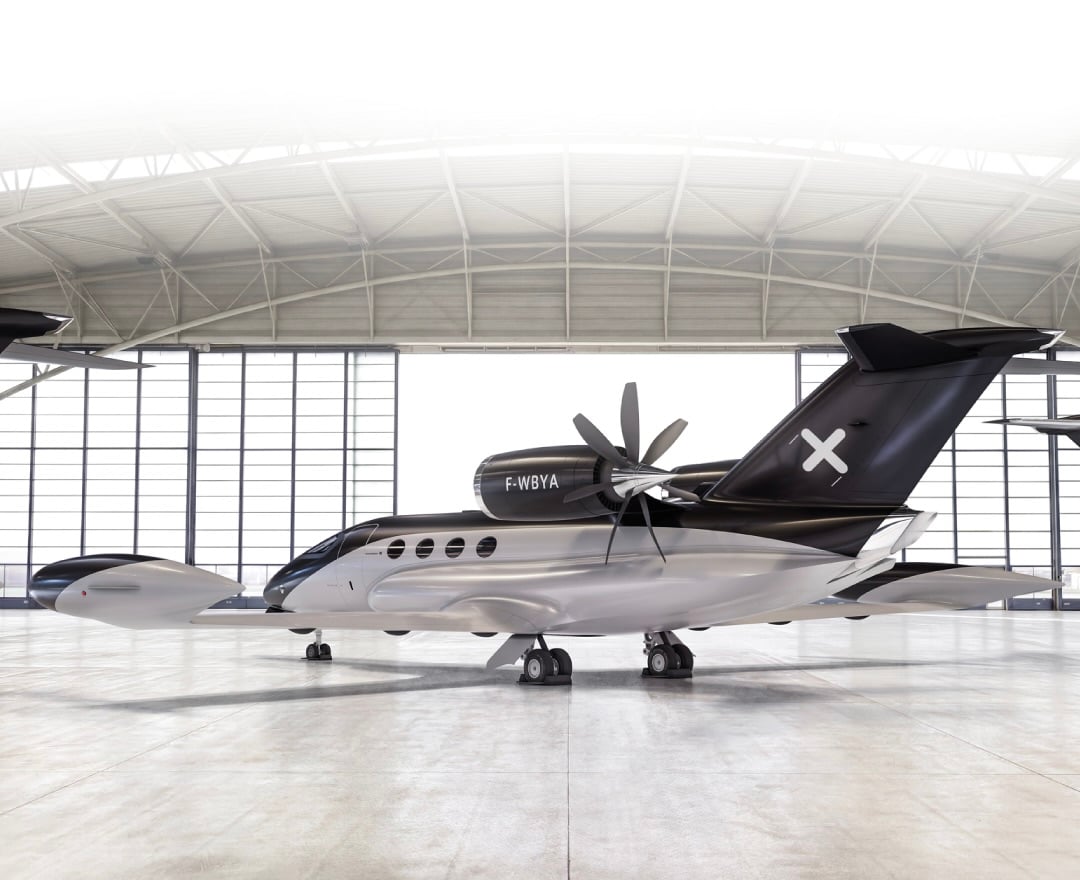
Luxaviation has committed to being the launch operator for Beyond Aero’s hydrogen-electric aircraft. In an agreement announced with the French start-up on Tuesday, the Europe-based business aviation services group said it will help to prepare a path to service entry for the eight-seat BYA-1 model, which is targeted for type certification in 2030.
According to the partners, their collaboration will focus on “real-world operational readiness,” including the definition of mission profiles and how the aircraft will be deployed and supported when operational. Luxaviation has not made any firm commitment for orders or delivery slots for the model, which is expected to have a range of 800 nm with six passengers on board.
Beyond Aero described the agreement as a “pre-commercial memorandum of understanding” and explained that Luxaviation’s involvement at this point is intended to “de-risk the path to service entry” for the BYA-1. The group, which provides aircraft management and charter services through multiple air operator certificates, will help to define how the jet could be deployed commercially through these business models.
Luxaviation said it will provide guidance on certification and market expertise, including factors such as “customer readiness” to travel in a hydrogen-powered aircraft, and how airport and FBO infrastructure can be prepared. It added that with the aircraft still in development, it is premature to confirm financial commitments to the program or make fleet commitments “before key technical and certification milestones are reached.”
Path to Market Takes Shape
In December, Beyond Aero announced plans to build a factory at its Toulouse headquarters. It aims to produce 60 examples of the BYA-1 in the first year of production, rising to 120 per year.
Last October, the company reported that its proprietary hydrogen-electric propulsion system had achieved technology readiness level 6, having demonstrated a full-scale example of the powertrain. This includes a 2.4-megawatt fuel cell stack and wing-mounted 700-bar gaseous hydrogen fuel tanks.
In January 2026, Beyond Aero completed wind tunnel tests with a one-eighth-scale model as part of the program’s now-completed preliminary design review. It aims to certify the BYA-1 under EASA’s CS-23 rules.
“Introducing a new propulsion system into business aviation requires operational discipline as much as technological innovation,” said Beyond Aero CEO Eloa Guillotin. “Partnering with Luxaviation ensures that hydrogen-electric propulsion is prepared for real missions, real operators, and real regulatory conditions.”
Luxaviation subsidiary Sigma Air Mobility has previously worked with other new aircraft developers, such as through a 2024 alliance with VoltAero, which has been working on a hybrid-electric family called the Cassio. Before that, in 2021, the group had considered involvement with Lilium’s now-abandoned eVTOL aircraft program.
“At Luxaviation, innovation must translate into real-world operations,” commented Caroline Demsar, CEO of Luxaviation France, Malta, and Portugal. “Partnering with Beyond Aero enables us to explore hydrogen-electric propulsion in a practical, responsible way, aligned with our long-term sustainability ambitions and operational excellence.”