Click Here to View This Page on Production Frontend
Click Here to Export Node Content
Click Here to View Printer-Friendly Version (Raw Backend)
Note: front-end display has links to styled print versions.
Content Node ID: 434017
Maintaining control and recovering from an encounter with poor weather remains a serious problem for helicopter and fixed-wing pilots. Even high-time instrument-rated pilots experience inadvertent entry into instrument meteorological conditions (IIMC) and, unless highly skilled and prepared, might not survive the encounter.
Black Hawk pilot Nick Sinopoli is trying to help pilots learn how to avoid the deadly results of IIMC encounters with the Icarus Smart View Limiting Device (VLD). The Icarus Smart VLD is a modern version of the typical hood or glasses that features eye panes with adjustable opaqueness, designed to limit pilots’ ability to see anything except the instrument panel and some of the obscured outside world, in an effort to better replicate flying in IMC. While the FAA requires VLDs for instrument training, it does not define exactly what these are, only dictating that pilots using them are “flying without utilizing outside visual references.”
According to the U.S. Helicopter Safety Team, “NTSB 2011 figures show that 45 of the 52 IIMC accidents occurring that year were fatal…that is 86%, giving you a 14% survivability rate if you go IIMC.”
Helicopter pilots are especially vulnerable during IIMC because helicopters are dynamically unstable. Without a stability augmentation system (SAS) or autopilot, if the pilot isn’t constantly maintaining precise control, the helicopter will rapidly diverge from controlled flight. In most fixed-wing aircraft, when trimmed, the airplane will maintain its trimmed attitude, at least long enough for the pilot to avoid losing control.
While it is equally important for fixed-wing pilots to practice IIMC encounters and recoveries, they have an advantage, thanks to built-in dynamic stability. For helicopter pilots, especially those with very little actual time flying on instruments in low visibility, practicing how to recover from an IIMC encounter is vital, especially in helicopters without SAS or an autopilot.
A problem with helicopter IFR training is that trainees rarely experience actual IMC. Much civil IFR training occurs in helicopters that aren’t qualified for actual IMC, mainly because they aren’t equipped with autopilots, so training must be done with a VLD. Another problem is that VLDs aren’t very limiting when it comes to helicopters because, unlike airplanes, most helicopters have much larger windows and chin bubbles that are easy to see through while wearing a device. Even pilots wearing the most restrictive of hoods or view-limiting glasses can see outside references—for example, when looking at a compass mounted on the glare shield or when looking at the edges of the instrument panel.
View-limiting Device Drawbacks
The other, more critical drawback of these devices is that they in no way replicate what it is like to fly from good to poor visibility in the real world. Generally, the weather is VMC, and the pilot hands the controls over to the instructor, puts the VLD on, then retakes control. This is the height of the training concept “negative transfer,” which means that learning is hobbled by learning something wrong earlier. Essentially, we’re teaching pilots that IMC happens suddenly, like a light switch, either on or off. In fact, IMC rarely happens in such a clear fashion; clouds are often not like a wall of white or gray sitting there waiting for hapless pilots to penetrate, but can materialize with a subtle and hard-to-detect gradual loss of visibility.
The Icarus Smart VLD replicates that visibility change, unlike other VLDs, by allowing the instructor to control the opacity of the eye panes, from clear to gradual reductions in visibility until it’s fully obscured. The opaque eye pane is made of a polymer-dispersed liquid-crystal film, and its carbon-fiber frame attaches to any conventional baseball hat.
To adjust the opacity, the instructor uses the Icarus app on a smartphone, which connects via Bluetooth to the Icarus VLD. The instructor can set various levels of opacity, from VMC to the worst heavy IMC, adjust the time for the opacity to change to replicate lowering visibility, or opt for a mode that simulates flying in and out of the clouds.
The panes come in different shapes with cutouts that accommodate various helicopter and airplane instrument panel layouts. A special pane is also available for night-vision-goggle operations to simulate reduced visibility in night operations.
Flying with the Icarus
I tested the Icarus Smart VLD with pilots in airplanes and helicopters, and flew with it myself to experience how it worked. Although I’m not a big fan of VLDs because they eliminate the important peripheral cues that all pilots, especially helicopter pilots, rely on, I thought the Icarus VLD was a significant improvement over glasses-type covers or the head-wearable hood that made my instrument training torturous.
The Icarus Smart VLD doesn’t eliminate the ability to see a bit underneath the panes, but it covers a lot more of the outside world than traditional VLDs. It does take up a lot of real estate in front of the face, and it’s important to try it on and get it adjusted properly before taking off. When I flew with it in a Guimbal Cabri G2 helicopter, I realized shortly after lifting off that I didn’t have it adjusted correctly and had to hand over the controls to the instructor while I got the device set up so it wouldn’t hit the side window when I turned my head.
Flying the helicopter on instruments was just as difficult with the Icarus Smart VLD as any hood or foggles, but the gradual lowering of visibility and adjustable opacity made it much more realistic while allowing me to look outside. This highlights a huge difference between the Icarus and traditional devices. With the Icarus, you are supposed to be able to see the outside world as represented with varying visibility. With traditional devices, you are not supposed to ever look outside but only at the instrument panel. This alone makes the Icarus Smart VLD much more useful for IMC practice.
My CFII instructor in the Cabri, Curtis Wilber at Pureflight Aviation Training in Chehalem, Oregon, tried the Icarus Smart VLD during our flight and thought it would be a valuable tool for IFR training. At $1,250, the cost isn’t a major stumbling block, although a busy school might need more than one.
Barry Munsterteiger, an instrument-rated pilot, tested the Icarus Smart VLD during some practice IFR approaches and said that he found it more comfortable than the hood he used during training. With the hood, he had to keep moving his head to view the instruments and avionics, but the cutout on the Icarus VLD was large enough that he didn’t have to move his head as much. He also appreciated being able to sense outside conditions better—for example, being able to see sunlight. “It’s similar to what you would feel in clouds,” he said. “With a normal hood, you just get light splashes. This is more natural than a completely opaque hood. It simulates clouds a lot more realistically.”
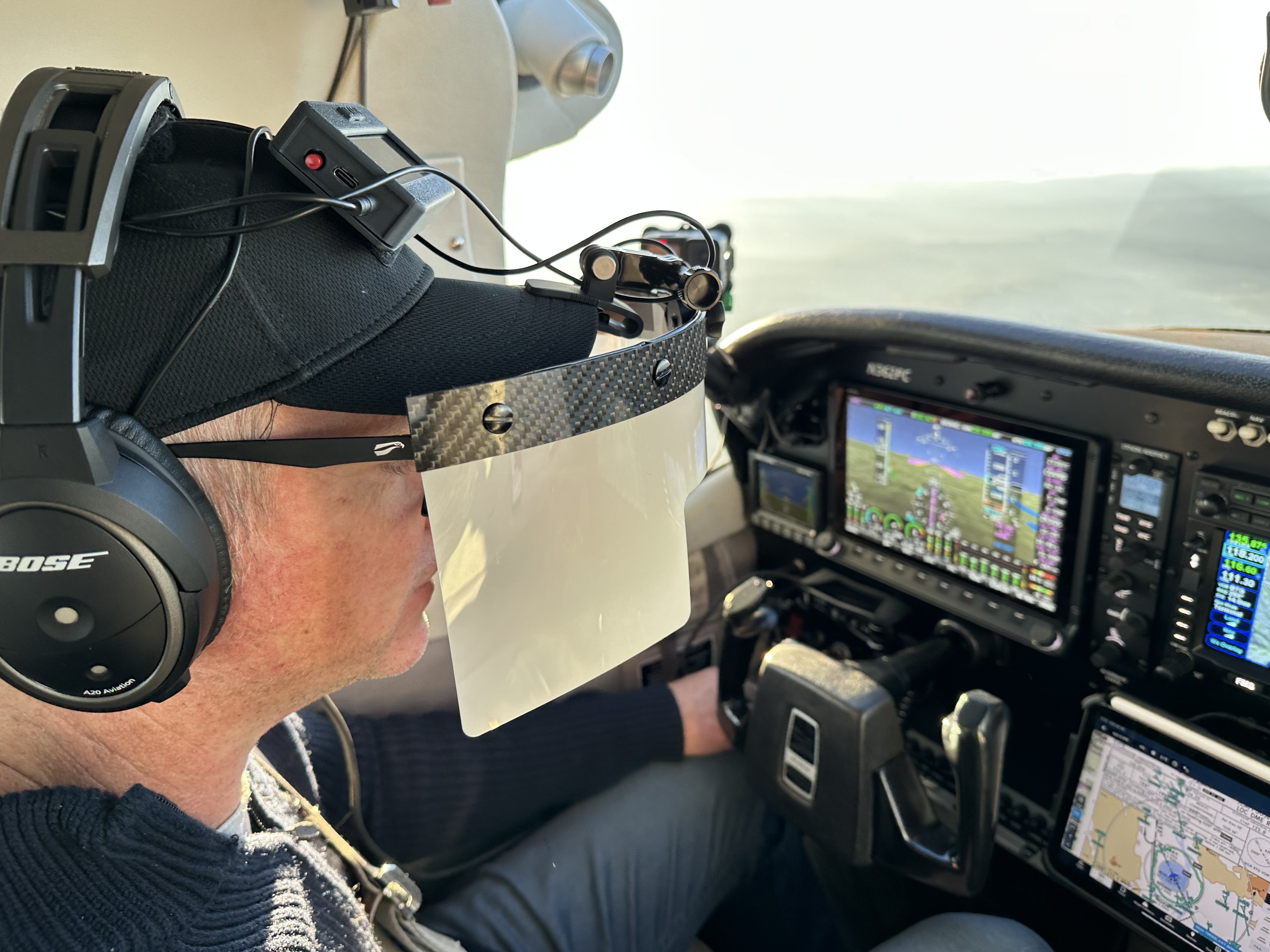
While airplane schools are using the Icarus Smart VLD, “Helicopters are where we started because the need is so acute,” Sinopoli said. The first “save” attributed to the Icarus VLD training was a helicopter pilot whose CFI had been one of the early testers of the device. The pilot and his son were on a fishing trip in a remote area in the Midwest U.S. without access to weather reporting, and they got caught in a gap that they thought was clear enough. During the IIMC encounter, the pitot tube got clogged, and the helicopter’s autopilot failed. “He was able to white-knuckle it around, exit IMC, and land,” Sinopoli said.
There have been other incidents since then, and each time, the practice with the Icarus VLD likely was a factor in helping the pilots recover. “If you’re not practicing [IIMC encounters and recovery],” he said, “how proficient are you?”
Sinopoli is well aware of the benefits of flight simulators for IFR and IIMC encounter training, but pointed out that few flight operations can afford their own simulator, and helicopter simulators are not widely available for training at reasonable prices. “All I’m trying to do is bring that simulator capability into the airplane,” he said. “Helicopters are all spread out. They are working aircraft. The great thing about the Icarus Smart VLD is if an air ambulance operator has one per base, they can maximize the training value.”