Click Here to View This Page on Production Frontend
Click Here to Export Node Content
Click Here to View Printer-Friendly Version (Raw Backend)
Note: front-end display has links to styled print versions.
Content Node ID: 433503
Brazil’s civil aviation authority has authorized Speedbird Aero to operate delivery drones over areas with population densities of up to 5,000 people per square kilometer (12,950 per square mile), marking a shift from route-by-route approvals to a scalable national framework for beyond-visual-line-of-sight (BVLOS) operations.
The decision by ANAC (Agência Nacional de Aviação Civil), announced on March 16, allows the company’s DLV-2 A25 model to fly over densely populated urban areas under pre-approved conditions and significantly expands the scope of its commercial drone operations in Brazil.
With headquarters in Brazil and Portugal, Speedbird develops, manufactures, and operates cargo drones under what it calls a “drone-as-a-service” model. Since its founding in 2018, the company has completed nearly 40,000 commercial drone missions across 14 countries, supporting applications ranging from food delivery to medical logistics and postal services.
“Unlike the previous scenario—in which each route required individual approval—the country is now adopting a framework that supports scale, predictability, and sustainable growth for the industry,” said Roberto Honorato, ANAC’s superintendent of airworthiness. “These regulatory measures enable Speedbird to implement advanced logistics models that are pioneering on a global scale.”
For Speedbird, ANAC’s latest approval paves the way for the company’s delivery-drone operations to grow from limited pilot projects into scalable logistics networks. “Logistics depends on repetition and predictability,” Speedbird said in a company statement, noting that drones are beginning to follow the same regulatory model as traditional transport modes like trucks, ships, and crewed aircraft.
Certification-first approach
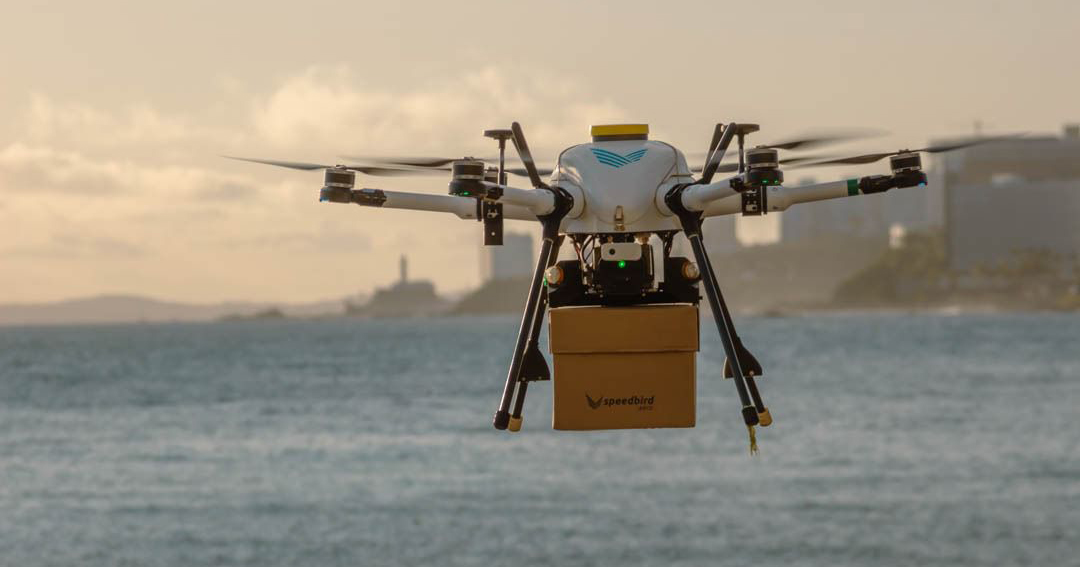
ANAC’s decision builds on prior validation of the safety performance of Speedbird’s equipment under the Specific Operations Risk Assessment (SORA) framework, including a Specific Assurance and Integrity Level III (SAIL III) authorization for a specific route in the state of Sergipe. The regulator also validated the effectiveness of safety features such as parachute recovery systems to mitigate ground risk.
While the DLV-2 A25 is approved for operations over areas with population densities up to 5,000 people per sq km, smaller platforms such as Speedbird’s DLV-1 model and other variants of the DLV-2 are limited to rural or suburban areas with population densities up to 500 people per sq km.
Speedbird executives said the company’s early focus on working with regulators shaped its development strategy. “From the very beginning, [we were] collaborating with the regulatory organization, not doing something and then asking, ‘Can I certify it?’” Speedbird board member Andre Stein told AIN. Stein, who joined the board of directors last August, previously served as CEO of electric aircraft developer Eviation and, before that, Eve Air Mobility.
A certification-driven approach, Stein explained, has helped the company replicate operations across multiple jurisdictions. “For me, it's one of these projects that does have the right pragmatic approach,” he said. “It's not about bells and whistles and doing things just for marketing. It's about getting it done, whatever the use might be.”

Aircraft family targets multiple use cases
Speedbird’s current operations are built around its multirotor DLV-1 and DLV-2 platforms, with a larger DLV-4 lift-plus-cruise eVTOL model in development.
The DLV-1 serves lower-density routes, including medical and rural logistics missions, where regulatory requirements are less stringent. It has a payload capacity of 2.5 kilograms (5.5 pounds), an mtow of 12.5 kilograms (27.6 pounds), and a range of three kilometers (1.6 nm).
With double the mtow and payload capacity, and nearly triple the range, the DLV-2 is the company’s primary commercial platform. It supports higher-density urban operations, including the delivery of “industrial items, beverage packs, biological materials, and multiple e-commerce orders,” according to Speedbird.
Designed for longer-range missions, the DLV-4 lift-plus-cruise eVTOL aircraft can carry up to five kilograms (11 pounds) for 40 kilometers (22 nm). It has a wingspan of four meters, whereas the DLV-2 has a wheelbase of 1.6 meters and the DLV-1 is just over one meter.
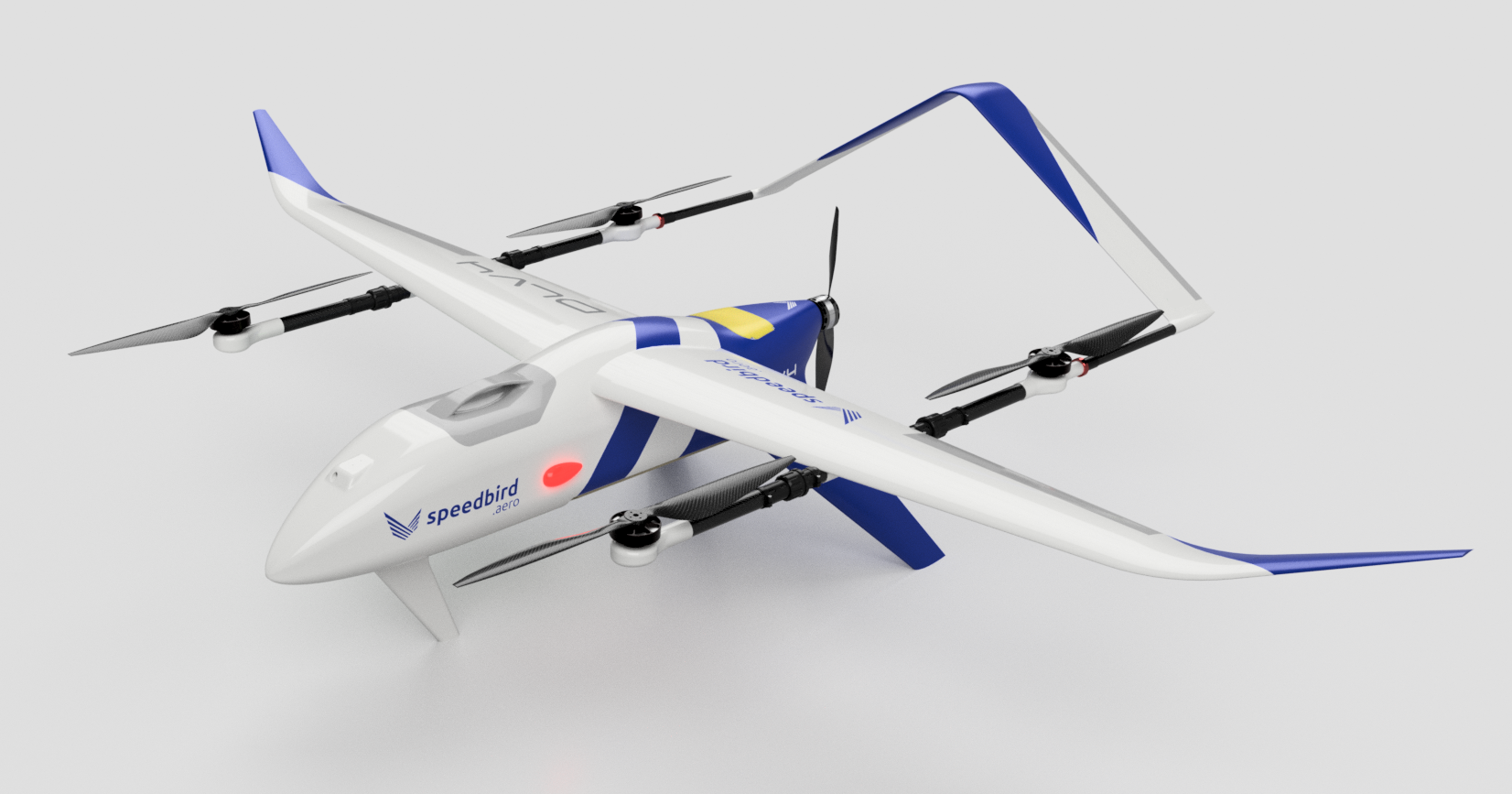
For its upcoming DLV-3 model, Speedbird is redesigning the DLV-4 for longer-range and higher-payload missions, including offshore and industrial logistics. “It’s not going to be for food delivery or the end-user experience,” Speedbird CEO Manoel Coelho told AIN. “It will be for middle-mile, longer routes… cargo, offshore, and similar missions.”
“The [DLV-4] is good, but we missed the mark on it in regards to competitiveness,” Coelho said. The newer DLV-3 model “will be much larger and more capable,” although it will feature a shorter wingspan, he said.
‘Droneports’ and infrastructure
Speedbird’s operational model combines fixed “droneports” with more flexible delivery methods. While dedicated landing zones can streamline operations, they are not always required.
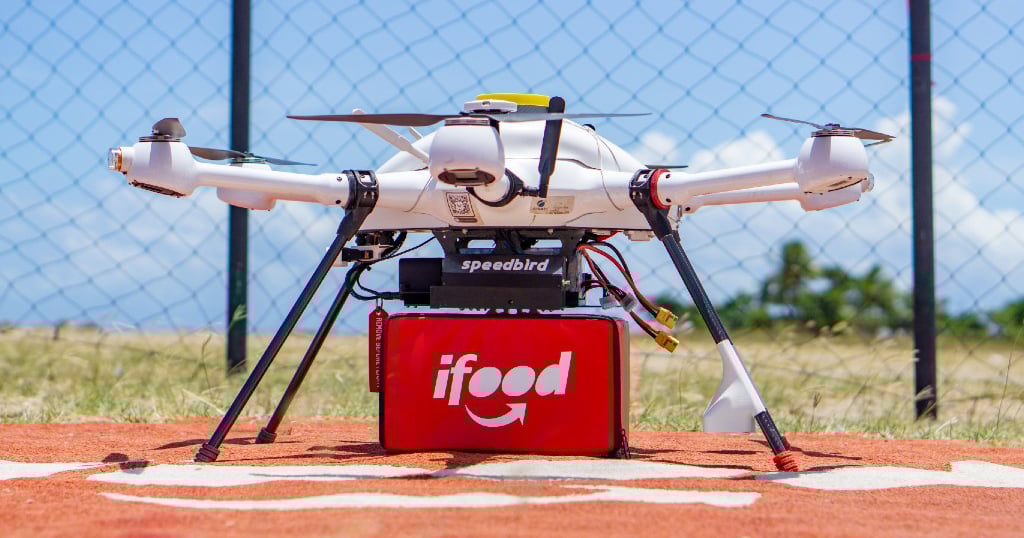
To receive a drone delivery via Speedbird, customers don’t necessarily need access to any specific type of ground infrastructure, Stein explained. In some cases, drones deliver via winch systems or land autonomously using visual markers. In others, droneports act as transfer hubs, where cargo is handed off to ground transport for the final leg.
Operators of Speedbird drones rely on centralized cloud-based control stations that allow pilots to manage flights remotely. Under BVLOS rules, remote pilots can be located anywhere within the country, rather than at the launch site. The aircraft are largely automated, with human oversight required for certain flight phases, particularly landings.
Bridging to advanced air mobility
Speedbird’s leadership views cargo drones as a precursor to broader advanced air mobility (AAM) operations, including passenger eVTOL aircraft.
“We're starting to look, in urban air mobility in general, at how to fly things within a city, and drones are already doing that,” Stein said. “[Drones] are starting to really push the envelope to fly within city limits.”
Stein explained that early drone operations are helping to define airspace integration, traffic management, and infrastructure concepts that will later support passenger services.
Speedbird has already demonstrated operations near airports and in shared airspace environments, including trials at Rome Fiumicino Airport and earlier work in Israel.
On March 12, vertiport developer and Speedbird partner UrbanV announced that Italy’s civil aviation authority (ENAC) had granted the country’s first SAIL III operational authorization as a result of the DLV-2 test campaign in Rome.
“Achieving SAIL III in Italy is a crucial step for the entire advanced air mobility ecosystem. With the DLV-2, we have demonstrated that it is possible to combine technological innovation, full regulatory compliance, and the highest safety standards when operating in complex urban environments,” Coelho said.
While Brazil has provided a regulatory proving ground, Speedbird is now targeting expansion into North America and Europe, where evolving BVLOS rules could unlock larger markets.
“It’s amazing the amount of business drones generate in Brazil… but the idea was always to go back to the U.S.,” Coelho said. “We have plenty of hours, plenty of problems that we have solved in Brazil and other parts, and now we can come back to the U.S. with this body of work that gives us the clout to request an audience with the FAA.”
With the FAA currently finalizing its new Part 108 drone rules, now is a good time to start engaging with the U.S. regulator, Coelho and Stein agreed.
“We see that 2026 will be a pivotal year,” Stein said. “Particularly, North America is seeing a lot of things happening [with] the regulatory environment that has been the bottleneck so far… With this proven, scalable solution already flying and being deployed in more and more markets, now is the right time. Now we can do it, and we can assure we can do it in a safe way in very different regulatory environments.”