Click Here to View This Page on Production Frontend
Click Here to Export Node Content
Click Here to View Printer-Friendly Version (Raw Backend)
Note: front-end display has links to styled print versions.
Content Node ID: 418687
An amendment to ban U.S. government use of Chinese and some other Chinese-made drones and other unmanned aircraft appears almost certain to become law within weeks. Contained within the 2021 National Defense Authorization Act (NDAA), the measure (Amendment to Rules Comm. Print 116-57, Subtitle C of Title VIII Sec. 8) bans the purchase of commercial drones made by a “covered foreign entity,” including China, by any U.S. government agency.
The ban covers both purchases of new drones and flights of drones already in government agency fleets, which would need to end within six months. It extends to related components including drivetrains, cameras, and circuit boards. Orders for components already contracted for could be completed up to one year following enacted. There would be some limited exemptions for the use of equipment by the Department of Homeland Security.
The amendment has survived both the House- and Senate-passed versions of the NDAA and seems assured to be in the final legislation that is presented for signature by President Trump. However, the draft legislation does not specify any weight limits for the aircraft it covers, making it uncertain as to whether it might also apply to larger eVTOL aircraft, such as those being developed by China's EHang. However, it does refer to the applicability to, "any off-the-shelf drone or covered unmanned vehicle," which would seem to allow scope for it to bar some eVTOLs.
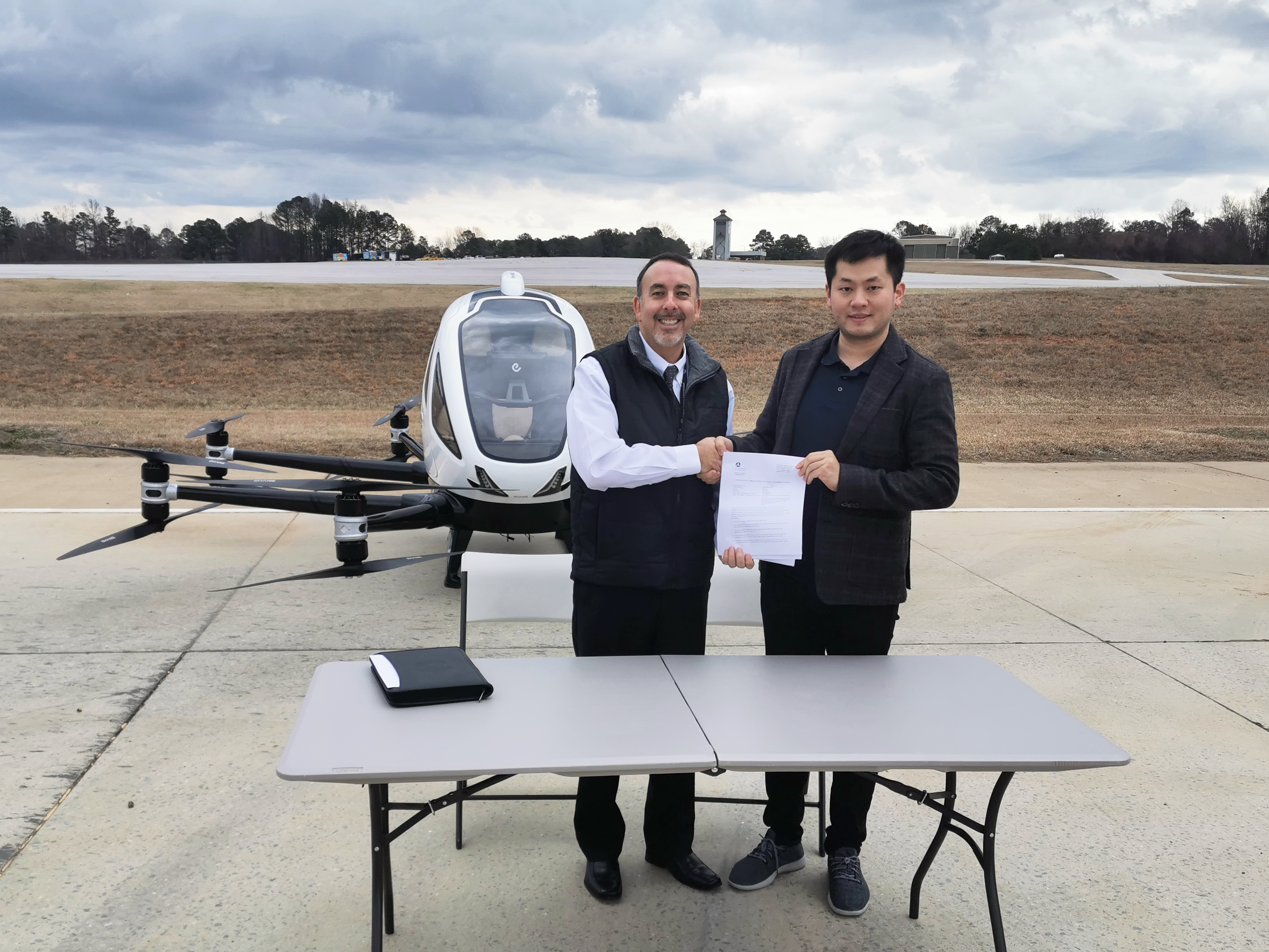
Until 2019, the U.S. market seemed to be a high priority for EHang, which in December completed an initial public offering on the Nasdaq stock market. Earlier in the year, EHang conducted some initial flight trials with its 216 Autonomous Aerial Vehicle with some cargo-carrying operations in North Carolina.
In early August, the Trump administration indicated that it intends to force Chinese companies with U.S. stock market listings to fully comply with the country's accounting rules. In 2019, as trade tensions were increasing between the two countries, the White House warned that it planned to ban Chinese companies from listing on U.S. exchanges, alleging that some have not been transparent about their financial status.
Announcing financial results for the second quarter of 2020 on August 25, EHang's management team said that the Chinese and European markets are now their priority, implying that this shift was due to restrictions associated with the Covid-19 pandemic. It made no reference to further development work in the U.S., but did point to a new partnership in neighboring Canada.
The amendment’s author, U.S. Rep. Mike Gallagher (Republican-Wisconsin), said the measure was necessary for national security. “Drones manufactured by foreign adversaries should be nowhere near the federal government. This equipment from countries like China uses taxpayer dollars to support the Chinese Communist Party’s near-monopoly on this critical market, while also posing a serious national security threat. It is imperative that Congress pass this bipartisan bill to protect U.S. interests, our communities, and our national security supply-chain.”
Originally offered last year as stand-alone legislation entitled “The American Security Drone Act,” the amendment prohibits the purchase of drones and components from countries deemed national security threats. The ban extends to the use of federal grants and contracts for the purchase of these items by state and local governments. The ban is aimed primarily at Chinese drone-maker DJI, which controls 70 percent of the U.S. drone market and has repeatedly denied that data from its drones is harvested by the Chinese government. In a statement released earlier this summer, the company said, “We design our systems so DJI customers have full control over how or whether to share their photos, videos and flight logs, and we support the creation of industry standards for drone data security that will provide protection and confidence for all drone users.”
However, security concerns prompted the U.S. Army to ban the use of DJI drones as early as 2017 and earlier this year the U.S. Department of Interior grounded its entire fleet of 800 DJI drones for similar reasons. Earlier this month, the security firm Synacktiv reported potential vulnerabilities in DJI’s security app. DJI called such claims “misleading” and said there was “no evidence of unexpected data transmission connections from DJI’s apps designed for government and professional customers.”