Click Here to View This Page on Production Frontend
Click Here to Export Node Content
Click Here to View Printer-Friendly Version (Raw Backend)
Note: front-end display has links to styled print versions.
Content Node ID: 418881
Russian startup Hover has unveiled a two-seat eVTOL design intended for air taxi operations. The company claims the aircraft will be ready to go into production by the end of 2021, although it does not anticipate widespread commercial use before 2023 or 2024.
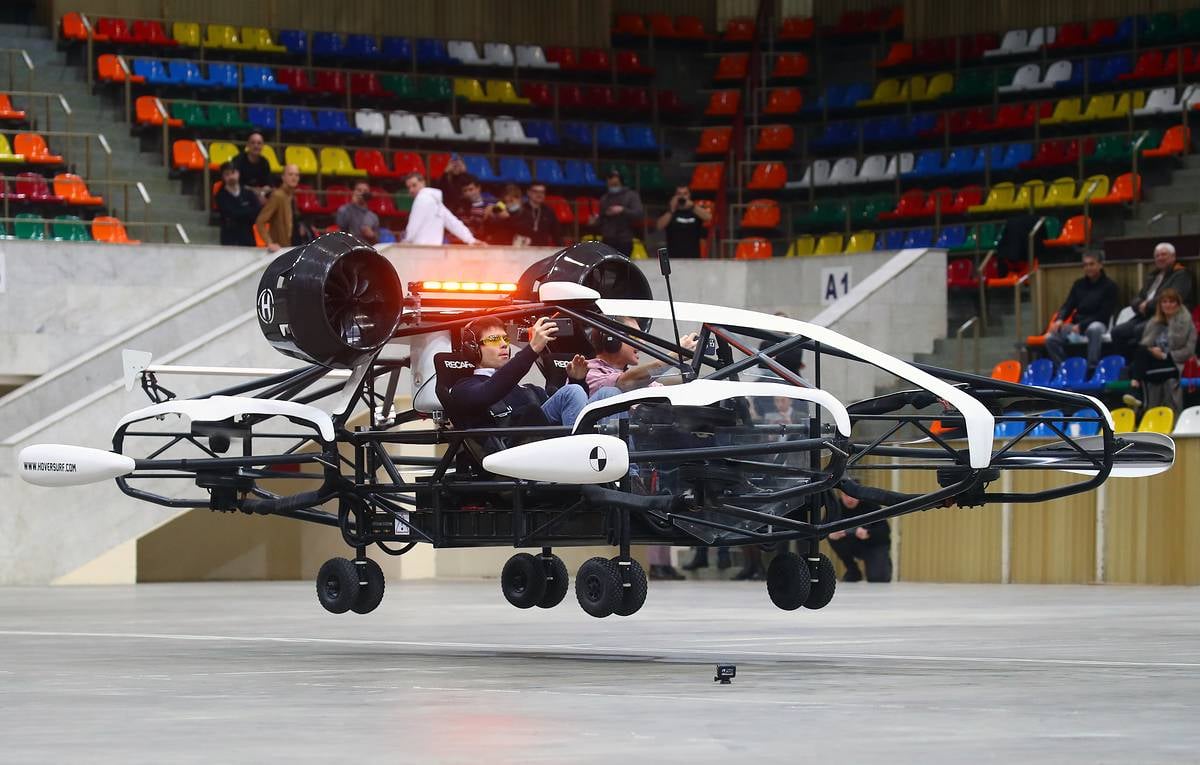
According to photos released by Hover, the first public flight of the prototype was made inside what appears to be an indoor stadium on January 21. However, the company says that it has already conducted extensive flight testing in various climates, ranging from high-temperature desert conditions to sub-zero weather in Russia.
The photo from the January 21 flight shows an open cockpit without the enclosed fuselage and fully ducted vertical fans seen in earlier images released on the Hover website. What appears to be a flight test model does include a pair of ducted fans to the rear of the fuselage for cruise flight.
The all-electric aircraft is expected to enter service with a range of around 100 km (62 miles) and a speed of 200 km/h (124 mph). Its projected maximum cruise altitude is just 150 meters (492 feet). The maximum payload is 300 kg (661 pounds).
Hover is one of several companies based in the Skolkovo Innovation Center near Moscow, which is sometimes described as Russia’s answer to Silicon Valley. Enterprises located in the facility, which was established with Russian government support just over 10 years ago, benefit from tax credits intended to encourage private investment.
The Hover team intends to start test flights in September, using 5G communications technology that they say will support the unnamed aircraft’s navigation system and, eventually, facilitate applications that passengers will use to book trips. For now, it would appear that the aircraft will be piloted as the company has made no mention of plans for autonomous operations. However, it does intend to develop a larger four-seat version.
Hover says the planned air taxi vehicle will be controlled using artificial intelligence and will also feature detect-and-avoid sensors, which implies that the company intends to support autonomous operations without a pilot on-board. However, it has not explained how it intends to achieve approval for autonomous operations, and it is hard to see how current rules could support its plans to have the aircraft in service by next year.
According to Hover CEO Alexander Atamanov, Moscow is set to be the first city to see commercial services with the aircraft, although he also sees potential for its use in other major cities, including New York. He expects consumer rideshare providers to be among the first to exploit the aircraft, but he also envisages demand from private owners and air ambulance services. The company expects to offer access to the aircraft this year to Russian search engine Yandex and other “taxi aggregators” and it will also open talks with Moscow city officials to agree on operating rules in the Russian capital.
Kirill Kayem, senior vice president for innovation at the Skolkovo Foundation, which runs the innovation center, acknowledged that work remains to be done to put in place the required supporting infrastructure, most notably recharging and battery storage facilities. He expressed confidence that this can be achieved in early-adopter cities such as Moscow and that the aircraft will be permitted to operate from existing parking lots for cars.
Hover is also developing a cargo drone and a single-seat electric flying motorbike called the Hoverbike, which has four open rotors. The Dubai police force has expressed interest in operating the Hoverbike.