Click Here to View This Page on Production Frontend
Click Here to Export Node Content
Click Here to View Printer-Friendly Version (Raw Backend)
Note: front-end display has links to styled print versions.
Content Node ID: 432473
At the start of each year, Leeham News and Analysis (LNA) gives its assessment of the challenges and opportunities facing leading aerospace companies. These in-depth features are available to subscribers, and here is a summary of the AIN Media Group platform’s key takeaways for the world’s leading airliner manufacturers, Airbus and Boeing.
Lars Wagner, who succeeded Christian Scherer as president and CEO of Airbus Commercial Aircraft on January 1, faces an array of supply chain issues and key decisions over the future of the A220 program and prospects for open-fan engine technology.
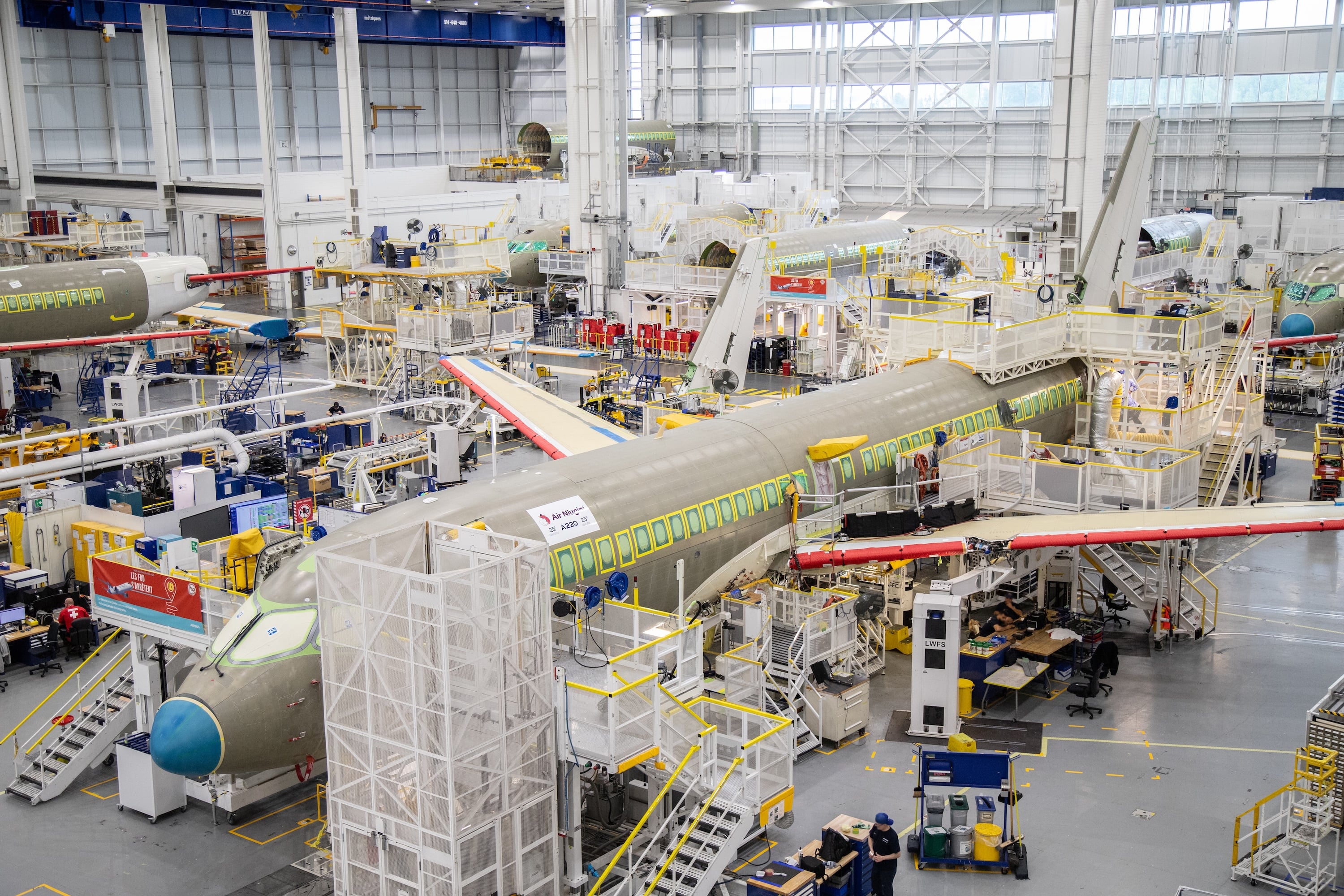
Airbus is seeking to ramp production of the A320 family to 75 aircraft per month by 2027, meanwhile boosting A220 production to 12 per month this year—a rate it aims to match for the A350 in 2028, followed by five A330s per month in 2029. Like its airframing rivals, engine makers, and other key suppliers, supply-chain stress continues to pose obstacles to these ambitions.
Quality-control issues on A320 fuselage panels that became public on December 1 pose another headache for Wagner. Those problems, among others, prevented Airbus from meeting its 2025 delivery target of 823 aircraft.
Over the next few years, Airbus’ leadership team is set to determine whether to stretch the A220-300 into an aircraft the size of the A320neo. It also faces a choice as to whether to select CFM International’s RISE open-fan engine for the anticipated A320 narrowbody replacement in the coming decade.
On the supply-chain front, the integration of several former parts of Spirit AeroSystems—most of which Boeing acquired in December—is high on the agenda. Airbus now owns the following assets:
- Kinston, North Carolina site that makes A350 fuselage sections
- A350 fuselage line in Saint-Nazaire, France
- Casablanca, Morocco factory that makes A321 and A220 components
- A220 wing and mid-fuselage production in Belfast, Northern Ireland
- Prestwick, Scotland site that produces wing components for the A320 and A350
Additionally, A220 pylon production, which has been handled by Spirit’s facility in Wichita, is now moving to the Airbus plant at Saint-Eloi, near Toulouse, France.
Spirit had been reporting losses on the A220 and A350 work for years. These losses are now absorbed into Airbus’ profit and loss (P&L) reporting. Airbus not only has the challenge of integrating all the former Spirit operations into its processes; it must figure out how to eliminate the costs that led to Spirit’s P&L losses.
The A220 has continued to operate at a loss since Airbus acquired the former Bombardier CSeries program in 2017. Wagner and his team now have to address how to breathe new life into the lower end of its narrowbody offering, while stemming financial burdens and resolving issues with its Pratt & Whitney Geared Turbofan engines.
On the upside, the A320neo family continues to dominate the single-aisle airliner sector, which is why boosting production rates is such an imperative for the European airframer.
Boeing Strives for Higher Production Rates
Airbus’ North American nemesis, Boeing Commercial Airplanes, is looking to build on the progress it made in 2025 in returning to profitability while restoring its tarnished reputation for reliability, quality, and safety. It also faces some key challenges and important decisions this year.
The path to Boeing’s technical and financial recovery flows through production. It ended 2025 with FAA authorization to proceed to a production rate of 42 737s a month—up from the 38 limit imposed by the agency after the January 2024 accident in which a door plug blew off a new 737 Max 9 after takeoff from Portland International Airport in Oregon.
For the 787, the production rate ended the year at seven per month. The rates for the 777F and 777X ticked over at a combined rate of between two and a half and three units. Production for the 767-300ER freighter and KC-46A military aircraft also ticked over at around the same rate.
Boeing expects to boost the monthly 737 rate to 47 by mid-year and 52 by year-end. However, some observers believe this may be optimistic. A survey of 35 suppliers by RBC returned a consensus that rate 52 won’t happen until 2027. Production of the 787 is expected to head to 10 per month by year’s end.
Once Boeing gets authority to boost the 737 rate to 52, it plans to activate its new North 737 production line at the Everett, Washington factory, which has been exclusively a widebody plant. Activation is slated for later this year. All Max 10 assembly lines will be at Everett.
One of the first decisions made by Kelly Ortberg, who was named Boeing CEO in August 2024, was to announce the termination of the commercial 767 program in 2027. The military 767-based KC-46A would continue. According to Cirium, the last 767-300ERF will be delivered this year.
In October, Boeing announced that certification of the 777X widebody will slip to 2026 and entry into service to 2027, as the FAA continues its in-depth review of the company’s flight testing and other processes.
Once certified, Boeing has some 30 777-9 models that have been built in open-air storage. Boeing knows that the FAA will require changes to these aircraft to reflect new information, software changes, and perhaps some hardware changes, but the extent remains unclear.
Development of the 777-8F freighter is underway. Service entry for this model is slated to be two years after the 777-9. The 777-8 passenger model is expected to follow about a year after the freighter.
In 2025, Boeing broke ground on an expansion of its 787 assembly site. Once completed in 2028, Boeing should be able to produce 14 of the widebodies each month. After a long sales drought, orders for the 787 poured in last year, filling current assembly line slots up to the next decade.
With slots for the rival Airbus A350 sold out and the A330-900 filling a niche role, Boeing was able to capitalize on near-term availability. Now, Boeing must add production capacity to continue winning deals. Even if Boeing gets the FAA’s authority this year to boost overall monthly production to 52 aircraft, the ability of the 737 to compete with Airbus’ A320neo family remains hampered, for now.
Certification of the smallest 737, the Max 7, and the largest, the Max 10, remains in limbo. Boeing hoped for certification in 2024, then 2025, and now 2026 as engineers design solutions for engine deicing issues. Southwest Airlines, the principal customer for the Max 7, said it expects certification of this model in August 2026 and entry into service in 2027.
No date has been suggested for certification of the Max 10. However, activation of the North Line will presumably be tied to the anticipated date. Still, according to some LNA sources, certification for both airplanes will slip yet again, to 2027.
Hand in hand with production increases, Boeing is working to improve safety and quality control protocols. The FAA won’t approve increasing production unless it is satisfied that Boeing meets several key performance indicators (KPIs) and maintains performance on these for a period of time.