Click Here to View This Page on Production Frontend
Click Here to Export Node Content
Click Here to View Printer-Friendly Version (Raw Backend)
Note: front-end display has links to styled print versions.
Content Node ID: 435106
Slower commercial traffic growth—in part triggered by the economic fallout from the Iran war—could mean that airlines are less concerned about continuing delays to new aircraft deliveries, according to consulting group McKinsey. Briefing reporters on data from its latest industry whitepaper on Thursday, McKinsey partner Frank Coleman suggested that, in weakening market conditions, getting some breathing space before receiving new equipment might suit their short-term tactical needs quite well.
In the longer term, though, McKinsey envisages what partner Kevin Sachs described as “a return to normalcy” with more than 2,000 narrowbodies in the global fleet beyond their expected retirement age. While noting that maintenance organizations and leasing companies have benefited from the deferred replacement of older aircraft, the group does not expect carriers to ask OEMs to push back deliveries of new equipment even further, not least because slots are so hard to get.
“Some of the teething issues with new engines and supply chain problems have benefited the airlines,” Coleman explained. “If they already had the extra capacity [from newly delivered aircraft], their revenue passenger kilometer [problem] would be even worse, or they would have had to park current aircraft.”
Nonetheless, consultants at IBA are predicting that up to 875 new airliner orders will be announced during the Farnborough International Airshow this week. On Thursday, the company said that around 480 of these will be narrowbody airliners, with around 280 widebodies, 75 regional jets, 25 twin turboprops, and 15 large freighters.
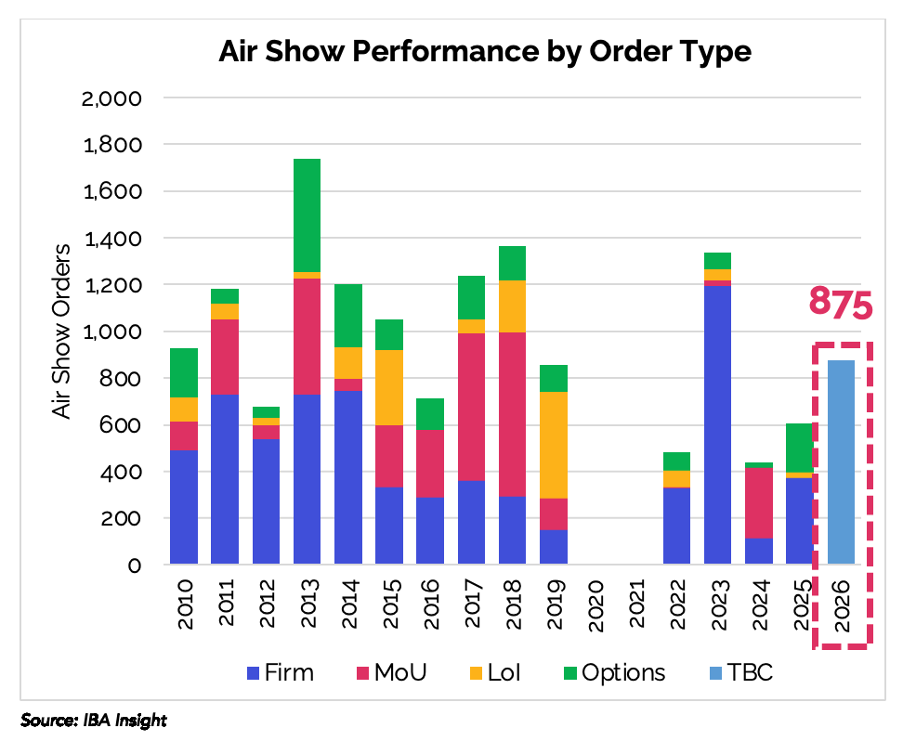
According to IBA, sales activity at the 2026 Farnborough show will mark an uptick on the 438 orders announced in 2024 and the 601 orders at the 2025 Paris Air Show. Its forecast said that airlines are in a “race for dwindling delivery slots.”
“Meaningful production positions for new Airbus A320neo-family and Boeing 737 Max aircraft have become increasingly limited until approximately 2033, while Airbus widebody slots only begin to become more accessible from 2032 and 2033,” IBA explained. “Boeing widebody availability remains constrained until around 2034, while delivery positions for the [Chinese] Comac C919 are similarly limited until approximately 2034 or 2035.”
Airbus and Boeing Crystal Balls
McKinsey published its somewhat sober assessment of the air transport sector a few days after Airbus and Boeing both issued their latest, and characteristically bullish, forecasts for future demand. McKinsey’s research found that many airlines have cut their growth outlook in half, with more than two-thirds of all industry respondents now expecting a market slowdown in the next two or three years.
On July 8, Airbus published its latest Global Market Forecast, predicting that between 2026 and 2045, there will be 42,060 new passenger airliner deliveries in response to a projected twofold increase in revenue passenger kilometers (RPKs) to 21.3 trillion. In addition to replacing aging aircraft, the European airframer said that airlines’ desire to expand their networks with longer, thinner routes connecting smaller cities and rising disposable income for travel in markets including Asia and Latin America are the key drivers of this anticipated growth.
In its new Commercial Market Outlook published on Friday, Boeing acknowledged that a 2.2% dip in the global economy combined with jet fuel prices spiking by 70% or more is set to deliver a $23 billion hit to airline profits this year. However, the U.S. airframer is predicting a 6% to 7% increase in RPKs in 2027.
Boeing’s forecasters see demand for 43,625 new airliner deliveries through 2045, with around two-thirds of these going to Asia. These deliveries are expected to be split almost evenly between replacements for aging aircraft and fleet expansion.
According to McKinsey, the timeline for the long-anticipated next-generation single-aisle airliners to replace the ubiquitous 737s and A320s continues to be pushed to the right. Sachs told reporters that this is due to multiple factors, including the industry’s struggle to ramp up production rates, the readiness of new technologies, and questions about the return on investment for new programs amid market uncertainty.