Click Here to View This Page on Production Frontend
Click Here to Export Node Content
Click Here to View Printer-Friendly Version (Raw Backend)
Note: front-end display has links to styled print versions.
Content Node ID: 428405
Trevor Milton purchased the SyberJet program two years ago and now plans to stretch the design of the SJ30-2 and add larger engines, new avionics, and fly-by-wire flight controls to develop the new $14 million SJ36. First flight of the SJ36 is projected in 2027, with FAA certification in 2032.
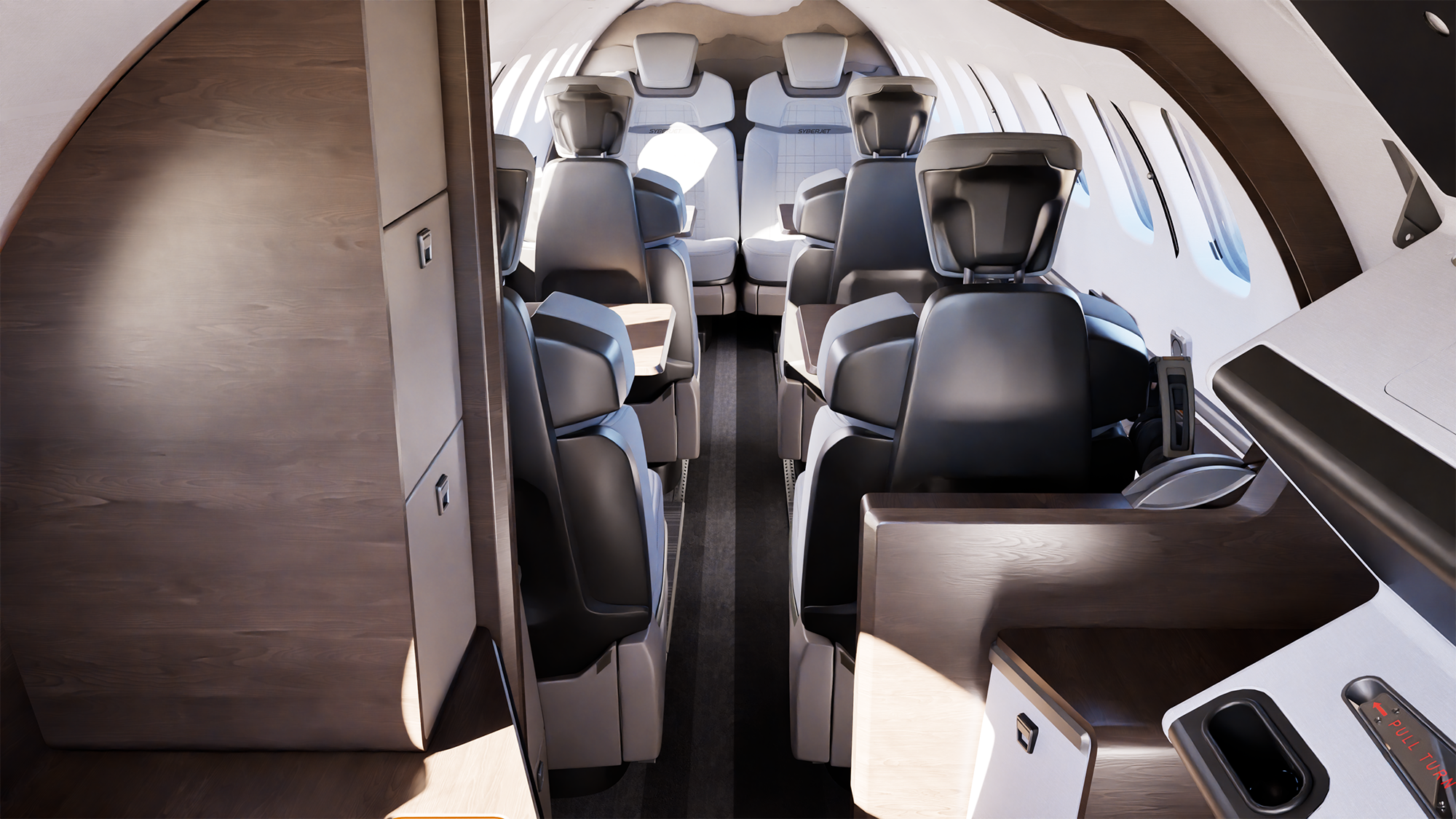
While the cabin’s width and height remain very similar to the SJ30-2’s, the four-foot stretch will enable seating for nine occupants. The SJ36’s Mmo is projected to be Mach 0.88, with a long-range cruise of Mach 0.74. Maximum altitude is the same as the SJ30-2’s—at FL490—as is the 12-psi cabin pressure differential, providing a sea-level cabin at FL410.
Only five SJ30-2s were built, with the final one purchased by actor Morgan Freeman. None are flying now, according to Milton, and SyberJet owns the airframes except for one non-flying SJ30-2 owned by an individual.
Milton soon plans to announce the selection for the SJ36’s engines, which will produce about 7,000 pounds of thrust combined. SyberJet will use one of the SJ30-2s as a flying testbed for the larger engines and for the SJ36’s avionics suite.
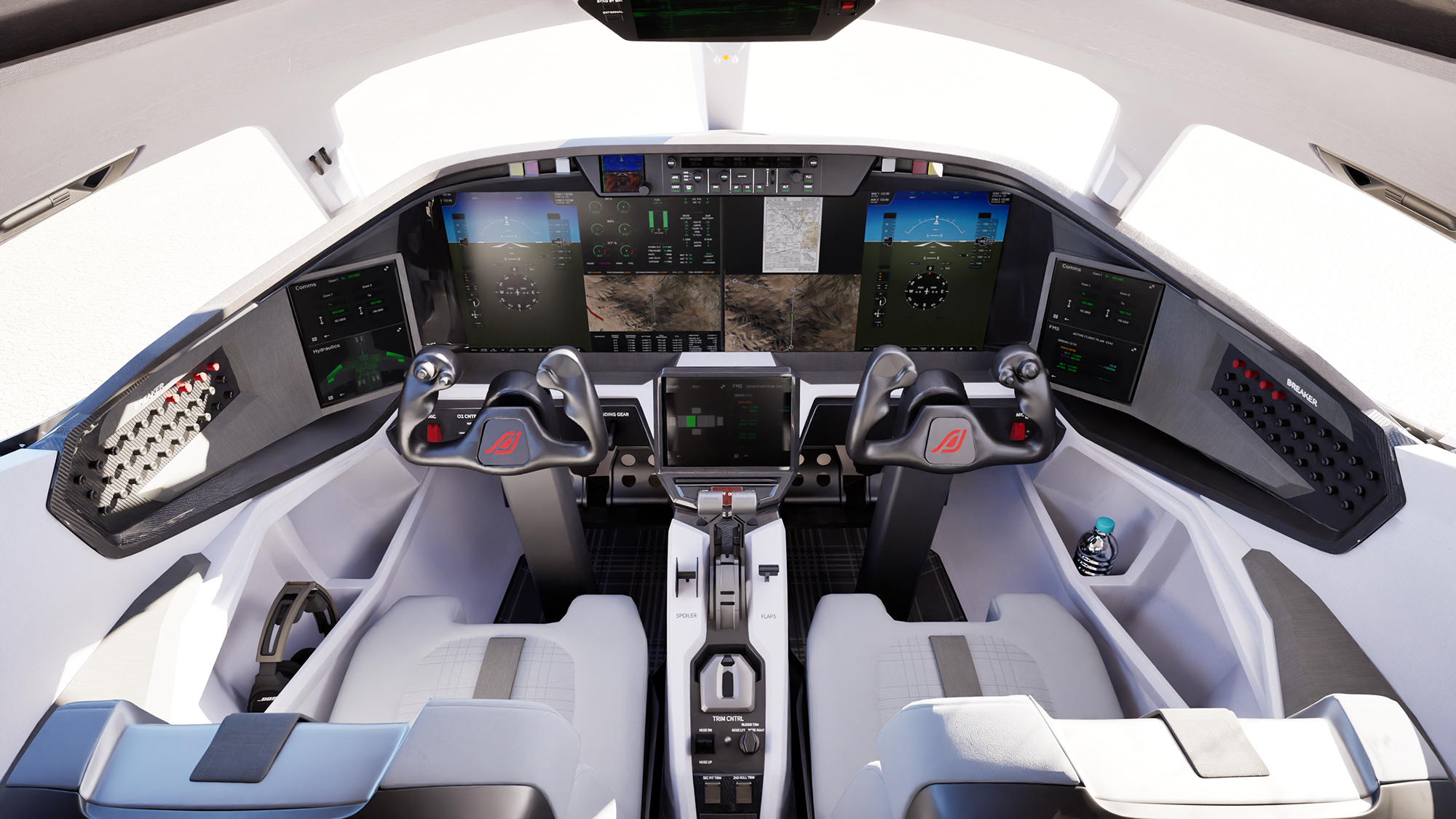
Unlike other jet manufacturers, SyberJet is designing the avionics for the SJ36, which will be an entirely new system but using the SyberVision brand name that SyberJet devised for its planned revamp of the SJ30-2, which never took flight. SyberVision will feature six touchscreen displays, a flight management system, autopilot, autothrottles, and secure over-the-air updates for databases and avionics upgrades.
The SJ36’s flight controls will be fly-by-wire, using the trim-stable design similar to Boeing and Gulfstream fly-by-wire configurations. SyberJet will work with fly-by-wire system manufacturers for flight control system components.
Another unique feature of the SJ36 will be a 14-kilowatt auxiliary power unit (APU) that doesn’t produce any emissions. Milton said he would reveal details on how the APU works later.
The advantage of a no-emissions APU is that pilots will be able to warm up or cool the airplane inside a hangar and remotely, using the connectivity available with SyberVision, he said.. This will also facilitate uploading flight plans and downloading diagnostics remotely, a capability already offered on many new aircraft.
With a projected mtow of 18,500 pounds, the SJ36 “is designed to bridge the gap between light and midsize jets,” according to the company. Development of new light jets that promise midsize-jet performance seems to be a trend, and the SyberJet is the third recent program with that goal, after the HondaJet Echelon and Otto Phantom 3500. All three are aiming for FAA Part 23 certification and thus will be single-pilot jets.
While it contributed to outstanding performance, the SyberJet’s smaller cabin has been one of its weak points, at 4.71 feet wide and 4.3 feet tall. The Phantom 3500 cabin is 7.5 feet wide and 6.4 feet tall, and it has a projected range of 3,200 nm. Honda Aircraft’s Echelon will offer less range at 2,625 nm, and it has a 5.08-foot-wide and 5.21-foot-high cabin.
Milton is a fixed-wing and helicopter pilot with more than 1,500 hours logged in a variety of aircraft, and his love of flying combined with his frustration with existing technology led him to acquire the SyberJet program.
“I love really complex problems,” he said, “if I can solve them. A lot of problems I encounter, I realized that I’m not the right guy to solve [them], it’s not my expertise. But with aviation…
“I was really frustrated that I came from the automotive world, where you can control your car from your phone. That’s what I helped design in my previous company [Nikola]. We were one of only three companies in the world to do that. It was Tesla, Rivian, Nikola, and I love the ability to control things from my phone. And I realized how angry I got every time I had to go do a Garmin update, I had to pull an SD card out of the screen and go plug in the computer. And it literally just got me angry. My blood was boiling, and I finally said, ‘screw it. I’m mad at all this.’ And at the same time, I was following the SyberJet, and I got the chance to finally buy it, and…I was going through a really hard time in my life at the time and I needed something to distract me. So that was what I did; I ended up buying SyberJet to distract me. And it turned out to be, I…nailed the nail on the head and perfect timing, perfect people, perfect everything.”
The hard time had to do with Milton’s former role as executive chairman and CEO of Nikola, and his conviction for securities and wire fraud and sentencing to four years in jail in late 2023, for which he was pardoned by President Trump. Recently, the Securities and Exchange Commission moved to dismiss its case against Milton.
“If someone doesn’t take me seriously, that’s to their own detriment,” Milton said. “That’s okay. I had some really dark days. It was tough. Five years of the worst five years a human can ever go through. I was indicted for something I didn’t do. I was framed. We found emails from the executives where they were framing me to take my stock away from me. They lied to the government. They provided false information. The government indicted me because they wanted to attack free speech, and Trump came in and gave me a full and unconditional pardon. His Department of Justice looked into it, and they said it was one of the worst cases they’ve ever seen. Trump came out and said, ‘He was absolutely innocent. He did nothing wrong.’ I mean, to get wording like that from the DOJ and the president of the United States is an honor of a lifetime.”
“When you go to battle, do you want to go to battle with a guy that’s had his ass kicked a lot in his life, like fought and won? Or do you want to go to battle with someone who’s never had their ass kicked? I’ve been through more hell and more learning experiences than just about anyone could ever dream of going through in their lifetime, and I came out alive, stronger, better, and much more wise. And I can tell you right now that, like anyone who doesn’t take me seriously, I hope they don’t…because it allows me to come in and completely overcome and overtake the entire aviation market. I’m going to take it over like Tesla did with the automotive world.”
SyberJet’s facilities include an office in San Antonio, Texas, with about 10 people, another in Cedar City, Utah, where former SyberJet owner MetalCraft was located, and the company headquarters in Phoenix. Selection of a location for a manufacturing facility is underway, and Milton said it will likely be in Utah or Arizona.
The company employs about 100 people now, including some contractors dedicated to the SyberJet program. Hiring is ramping up, and Milton expects that number to grow to 1,500 as the program progresses. He expects the costs of the program to be about $1 billion, including $250 million for design activities and $750 million to set up the factory.
“I’ve got people working on this now,” he said—“all the main engineers that worked for me at Nikola, like the chief engineer, the chief technology officer, all the guys that I trusted that are really good. They brought all that knowledge and intellectual property about how to do over-the-air [updates], how to build electronics.”
Milton didn’t take the decision to design the SJ36’s avionics lightly, and he did consult with avionics OEMs such as Honeywell, which made the SJ30-2’s avionics, as well as Garmin. “We went to the different avionics groups and they told us to go pound sand,” he said. “So we developed the most advanced avionics system, I think, in the world now, mainly because we got told to go pound sand, and so it was almost out of necessity. We’re doing everything from the ground up, all of it.
“It’s the only avionics system where you’ll be able to control the plane through your phone. I’ll be able to turn the plane on inside of a hangar. We built the first-ever zero-emission APU. We can power up the entire plane, we can run HVAC, and we can do it inside of a hangar. It’s the coolest stuff ever.”
Milton is planning to seek an update of the SJ30-2 type certificate instead of applying for an all-new type certificate from the FAA. “There are major changes to this plane. We do have new engines. Avionics are a major change, because [fly by wire] changes the flight controls. Our goal is to try…to change the FAA a little bit to where we can prove that we can do everything that the old SyberJet can do, but even better and safer with more redundancy, and try to simplify some of these processes that were stifling to American companies. I can’t guarantee that, but the Trump Administration is big behind [wanting] aviation built in America.
“They don’t like the chaos or the complexity that has come from Boeing. It’s unfortunate because Boeing has essentially almost destroyed the small aviation markets…because of the things that they faced. The FAA has applied the same logic to the small guys like us and almost suffocated small guys, because we don’t have the ability to just take a $2 billion a year loss like Boeing does. So our goal is to try to simplify the FAA, especially for smaller jet manufacturing, to have it in different types of categories to where they’re applicable to different rules and standards. But even if we don’t get any of the changes done, I think that the SJ36 is still going to meet its timeline within 2032. But we’ll see what happens with the FAA, because we have a new wing on the SJ36. So we just don’t know what they’re gonna require yet.”
As for the SJ36’s cabin, Milton said his engineers have been able to squeeze from 1 to 3 more inches of width by redesigning the environmental system, systems attachments, and lighting to take up less space. “We’re able to save almost 2 inches of where your head is,” he said. “That’s a big deal…because that fuselage is already small.”
The SJ36 wing will have two degrees of additional sweep compared to the SJ30-2. SyberJet is retaining the existing landing gear configuration, which retracts into the fuselage, not the wings. “We get a little bit more height with our landing gear than you would get with a normal landing gear,” he said. “And it gives a little bit more room for those wings to have some rudder control in a crosswind…where you’re not striking that wing as easily as you would a normal swept wing.”
Milton explained that the SyberJet team has been running simulations of the design, and the SJ36’s carbon-ceramic braking system and larger tires will deliver better landing performance. “We’re trying to get our Vref down below 108 knots, which I think we’re going to achieve…we should be down in the very low 2,000-foot stopping range. We don’t know the exact numbers yet…until we are flying the plane. But our simulation should be within a few percent accuracy.”
He is hoping to finalize the SJ36 design in the next six months. “I am lucky that a very brilliant man named Ed Swearingen designed an incredible plane. In my previous company, I had to build something from scratch. That was hard. Aviation is 10 times harder than anything I’ve done in automotive.”
SyberJet Aircraft is putting more pieces in place for the light-jet program that Trevor Milton is hoping to resurrect. Milton, founder and former executive chairman and CEO of Nikola, unveiled his plans to revive a version of the Syberjet just ahead of NBAA-BACE in October. And then at NBAA-BACE, SyberJet inked a deal with Williams International, designating the 3,621-pound-thrust FJ44-4A as the twinjet’s powerplant.
Milton, who purchased the SyberJet program two years ago, has detailed plans to stretch the design of the SJ30-2 and add larger engines, new avionics, and fly-by-wire flight controls to develop the new $14 million SJ36. First flight of the SJ36 is projected in 2027, with FAA certification in 2032.
While the SyberJet’s cabin width and height remain very similar to the SJ30-2’s, the four-foot stretch will enable seating for nine occupants. The SJ36’s Mmo is projected to be Mach 0.88, with a long-range cruise of Mach 0.74. Maximum altitude is the same as the SJ30-2’s—at FL490—as is the 12-psi cabin pressure differential, providing a sea-level cabin at FL410.
With a projected mtow of 18,500 pounds, the light jet will achieve a 38.9% thrust-to-weight ratio, enabling strong climb performance and efficient high-altitude cruise. The SJ36’s four-foot shorter predecessor, the FAA-certified SJ30-2, was fitted with two 2,300-pound-thrust FJ44-2A turbofans.
“Williams International is the clear choice for this program,” said Milton, who is CEO of SyberJet Aircraft, adding that the partnership is more than an engine deal, but a “shared vision for what the next generation of light jets should be.” He acknowledged that there were other manufacturers to choose from, but ultimately, the decision came down to his trust in the Williams engine family.
Gregg Williams, chairman and CEO of Williams International, called the FJ44-4A “a perfect match for the SJ36.”
The collaboration will be highlighted in SyberJet’s upcoming YouTube series documenting the SJ36’s development. Produced in partnership with pilot and influencer Dave “Heavy D” Sparks, the series offers viewers an inside look at the aircraft certification process from design and testing to production. Milton said the goal is to make the process accessible to aviation enthusiasts and demonstrate “what it really takes to build a modern airplane.”
Meanwhile, SyberJet is designing the avionics for the SJ36, which will be an entirely new system but using the SyberVision brand name that SyberJet devised for its planned revamp of the SJ30-2, which never took flight. Milton said SyberJet’s home-grown suite will feature secure over-the-air updates for databases and flight management software. The platform is said to include six high-definition touchscreens, integrated autothrottle, fly-by-wire controls, and enhanced weather systems.
“Our engineers and pilots have built an avionics package that’s more capable and easier to use than anything else in its class,” he said.
SyberJet will use one of the SJ30-2s as a flying testbed for the larger engines and for the SJ36’s avionics suite.
The SJ36’s flight controls will be fly-by-wire, using the trim-stable design similar to Boeing and Gulfstream fly-by-wire configurations. SyberJet will work with fly-by-wire system manufacturers for flight control system components.
A unique feature of the SJ36 will be a 14-kilowatt auxiliary power unit (APU) that doesn’t produce any emissions. Milton said he would reveal details on how the APU works later. The advantage of a no-emissions APU is that pilots will be able to warm up or cool the airplane inside a hangar and remotely, using the connectivity available with SyberVision, he said. This will also facilitate uploading flight plans and downloading diagnostics remotely, a capability already offered on many new aircraft.
With its 18,000-pound mtow, the SJ36 “is designed to bridge the gap between light and midsize jets,” according to the company. Development of new light jets that promise midsize-jet performance seems to be a trend, and the SyberJet is the third recent program with that goal, after the HondaJet Echelon and Otto Phantom 3500. All three are aiming for FAA Part 23 certification and thus will be single-pilot jets.
While it contributed to outstanding performance, the SyberJet’s smaller cabin has been one of its weak points, at 4.71 feet wide and 4.3 feet tall. The Phantom 3500 cabin is 7.5 feet wide and 6.4 feet tall, and it has a projected range of 3,200 nm. Honda Aircraft’s Echelon will offer less range at 2,625 nm, and it has a 5.08-foot-wide and 5.21-foot-high cabin.
Milton is a fixed-wing and helicopter pilot with more than 1,500 hours logged in a variety of aircraft, and his love of flying combined with his frustration with existing technology led him to acquire the SyberJet program.
“I love really complex problems,” he said, “if I can solve them. A lot of problems I encounter, I realized that I’m not the right guy to solve [them], it’s not my expertise. But with aviation…
“I was really frustrated that I came from the automotive world, where you can control your car from your phone. That’s what I helped design in my previous company [Nikola]. We were one of only three companies in the world to do that. It was Tesla, Rivian, Nikola, and I love the ability to control things from my phone. And I realized how angry I got every time I had to go do a Garmin update, I had to pull an SD card out of the screen and go plug in the computer. And it literally just got me angry. My blood was boiling, and I finally said, ‘screw it. I’m mad at all this.’ And at the same time, I was following the SyberJet, and I got the chance to finally buy it, and…I was going through a really hard time in my life at the time, and I needed something to distract me. So that was what I did; I ended up buying SyberJet to distract me. And it turned out to be, I…nailed the nail on the head and perfect timing, perfect people, perfect everything.”
The hard time had to do with Milton’s former role as executive chairman and CEO of Nikola, and his conviction for securities and wire fraud and sentencing to four years in jail in late 2023, for which he was pardoned by President Trump. Recently, the Securities and Exchange Commission moved to dismiss its case against Milton.
“If someone doesn’t take me seriously, that’s to their own detriment,” Milton said. “That’s okay. I had some really dark days. It was tough. Five years of the worst five years a human can ever go through. I was indicted for something I didn’t do. I was framed. We found emails from the executives where they were framing me to take my stock away from me. They lied to the government. They provided false information. The government indicted me because they wanted to attack free speech, and Trump came in and gave me a full and unconditional pardon. His Department of Justice looked into it, and they said it was one of the worst cases they’ve ever seen. Trump came out and said, ‘He was absolutely innocent. He did nothing wrong.’ I mean, to get wording like that from the DOJ and the president of the United States is an honor of a lifetime.
“When you go to battle, do you want to go to battle with a guy that’s had his ass kicked a lot in his life, like fought and won? Or do you want to go to battle with someone who’s never had their ass kicked? I’ve been through more hell and more learning experiences than just about anyone could ever dream of going through in their lifetime, and I came out alive, stronger, better, and much more wise. And I can tell you right now that, like anyone who doesn’t take me seriously, I hope they don’t…because it allows me to come in and completely overcome and overtake the entire aviation market. I’m going to take it over like Tesla did with the automotive world.”
SyberJet’s facilities include an office in San Antonio, Texas, with about 10 people, another in Cedar City, Utah, where former SyberJet owner MetalCraft was located, and the company headquarters in Phoenix. Selection of a location for a manufacturing facility is underway, and Milton said it will likely be in Utah or Arizona. The company employs about 100 people now, including some contractors dedicated to the SyberJet program. Hiring is
ramping up, and Milton expects that number to grow to 1,500 as the program progresses. He expects the costs of the program to be about $1 billion, including $250 million for design activities and $750 million to set up the factory.
“I’ve got people working on this now,” he said—“all the main engineers that worked for me at Nikola, like the chief engineer, the chief technology officer, all the guys that I trusted that are really good. They brought all that knowledge and intellectual property about how to do over-the-air [updates], how to build electronics.”
Milton didn’t take the decision to design the SJ36’s avionics lightly, and he did consult with avionics OEMs such as Honeywell, which made the SJ30-2’s avionics, as well as Garmin. “We went to the different avionics groups and they told us to go pound sand,” he said. “So we developed the most advanced avionics system, I think, in the world now, mainly because we got told to go pound sand, and so it was almost out of necessity. We’re doing everything from the ground up, all of it.
“It’s the only avionics system where you’ll be able to control the plane through your phone. I’ll be able to turn the plane on inside a hangar. We built the first-ever zero-emission APU. We can power up the entire plane, we can run HVAC, and we can do it inside a hangar. It’s the coolest stuff ever.”
Milton is planning to seek an update of the SJ30-2 type certificate instead of applying for an all-new type certificate from the FAA. “There are major changes to this plane. We do have new engines. Avionics are a major change because [fly by wire] changes the flight controls. Our goal is to try…to change the FAA a little bit to where we can prove that we can do everything that the old SyberJet can do, but even better and safer with more redundancy, and try to simplify some of these processes that were stifling to American companies. I can’t guarantee that, but the Trump Administration is big behind [wanting] aviation built in America.
“They don’t like the chaos or the complexity that has come from Boeing. It’s unfortunate because Boeing has essentially almost destroyed the small aviation markets…because of the things that they faced. The FAA has applied the same logic to the small guys like us and almost suffocated small guys, because we don’t have the ability to just take a $2 billion a year loss like Boeing does. So our goal is to try to simplify the FAA, especially for smaller jet manufacturing, to have it in different types of categories where they’re applicable to different rules and standards. But even if we don’t get any of the changes done, I think that the SJ36 is still going to meet its timeline within 2032. But we’ll see what happens with the FAA, because we have a new wing on the SJ36. So, we just don’t know what they’re gonna require yet.”
As for the SJ36’s cabin, Milton said his engineers have been able to squeeze from 1 to 3 more inches of width by redesigning the environmental system, system attachments, and lighting to take up less space. “We’re able to save almost 2 inches of where your head is,” he said. “That’s a big deal…because that fuselage is already small.”
The SJ36 wing will have two degrees of additional sweep compared to the SJ30-2. SyberJet is retaining the existing landing gear configuration, which retracts into the fuselage, not the wings. “We get a little bit more height with our landing gear than you would get with a normal landing gear,” he said. “And it gives a little bit more room for those wings to have some rudder control in a crosswind…where you’re not striking that wing as easily as you would a normal swept wing.”
Milton explained that the SyberJet team has been running design simulations, and the SJ36’s carbon-ceramic braking system and larger tires will deliver better landing performance. “We’re trying to get our Vref down below 108 knots, which I think we’re going to achieve…we should be down in the very low 2,000-foot stopping range. We don’t know the exact numbers yet…until we are flying the plane. But our simulation should be within a few percent accuracy.”
He is hoping to finalize the SJ36 design in the next six months. “I am lucky that a very brilliant man named Ed Swearingen designed an incredible plane. In my previous company, I had to build something from scratch. That was hard. Aviation is 10 times harder than anything I’ve done in automotive.”