Click Here to View This Page on Production Frontend
Click Here to Export Node Content
Click Here to View Printer-Friendly Version (Raw Backend)
Note: front-end display has links to styled print versions.
Content Node ID: 429472
The Commercial Aircraft Corporation of China (Comac) is seeking to break into the large-cabin VIP aircraft market with a modified version of the C909 narrowbody airliner. The state-backed airframer believes the Comac Business Jet (CBJ) will prove attractive, especially in an Asia-Pacific regional market that has long been dominated by leading Western manufacturers.
Comac’s 90-seat ARJ21-700 airliner, which has since been rebranded as the C909, is the original CBJ airframe. In March 2021, the Civil Aviation Administration of China issued the aircraft’s type certificate validation, almost six years after the airliner was approved. None of Comac's aircraft have achieved type certification with either EASA or the FAA.
Typical CBJ cabin configurations seat between 12 and 19 passengers, but it can be fitted out with 29 seats. Powered by a pair of General Electric CF34-10A engines, the range with eight passengers is around 2,700 nm, and the aircraft cruises at 520 knots with a certified altitude ceiling of 39,000 feet.
The CBJ has been validated to operate at high-altitude airfields such as China’s Daocheng Yading Airport at 14,470 feet. The twinjet’s required takeoff roll is 6,722 feet.
Competing with large-cabin business jets produced by Gulfstream, Bombardier, Embraer, Dassault, Airbus, and Boeing, Comac offers several customizable cabin configurations. What the manufacturer calls Plan A seats 15 passengers with 11 luxury seats, two couches, a pair of business-class seats, a VIP suite, two lavatories, and two crew seats. Plan B accommodates 13 passengers with six couches, five luxury seats, two business-class seats, a VIP suite, two lavatories, and one crew seat.
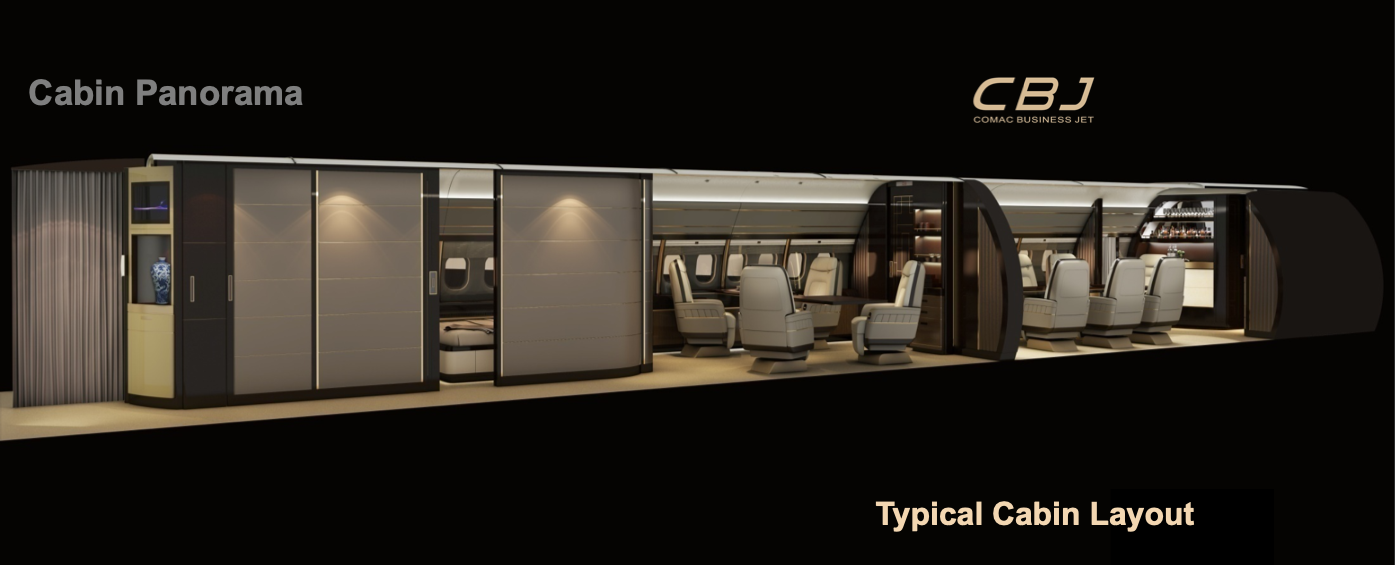
Plan C maximizes lounge space for 17 passengers with 12 couches, three luxury seats, two business-class seats, a VIP suite, two lavatories, and one crew seat. Plan D seats 18, balancing nine luxury seats, three couches, six business-class seats, nine flat-available seats, a VIP suite, two lavatories, and one crew seat. Plan E is fitted out for the highest passenger capacity (29 passengers) with 22 business-class seats, four luxury seats, three couches, two flat-available seats, a VIP suite, two lavatories, and two crew seats.
The VIP suite features a double bed and private lavatory, a reception area with lie-flat first-class seats, and a meeting/dining area with an eight-seat table and satellite phone. The rear cabin area includes a bar, coffee station, oven, and flight attendant seat, while sound insulation keeps noise levels as low as 55 dB in the VIP suite and below 65 dB elsewhere.
Optional phased-array broadband satellite communications equipment provides high-speed internet. According to Comac, foldable boarding ladders enhance operational flexibility at airports without jet bridges.
The Chinese jet has significant foreign content onboard, beyond the U.S.-made engines. Western suppliers include Collins Aerospace (avionics), Liebherr (air management, landing gear, anti-icing, and air supply systems), Parker (fuel system, hydraulic energy systems, and actuation systems), Hamilton Sundstrand (electronic system, flap and slat system, APU, and primary flight controls for rudder, elevator, aileron, and interceptor), FACC (winglets), Eaton (fuel casing system and control panel and lights control system), Kidde Aerospace (fire-protection system), and Goodrich (lighting system).
CBJ operators can benefit from the extensive technical support Comac has put in place for more than 170 C909s it has so far delivered to airlines in China and across Southeast Asia. The manufacturer also produces the larger C919 airliner, seating up to 192 passengers, and is developing a 280-seat widebody called the C929 with intercontinental range.