Click Here to View This Page on Production Frontend
Click Here to Export Node Content
Click Here to View Printer-Friendly Version (Raw Backend)
Note: front-end display has links to styled print versions.
Content Node ID: 433184
Honeywell has released the latest of its FMS guided visual (FGV) approaches to one of the most challenging airports in the U.S., Runway 33 at Aspen/Pitkin County Airport (KASE). Most pilots land on Aspen’s Runway 15, but if the winds favor Runway 33, it’s difficult to safely fly a stabilized visual approach due to mountainous terrain near the runway end.
FGV approaches are loaded from the flight management system (FMS) and designed to guide the flight crew safely to the runway end with comfortable angles of bank and descent, on a stabilized approach, while avoiding problem areas such as terrain, airspace, obstacles, or other encroachments.
Nearly 100 FGV approaches are expected to be available by April, according to Honeywell. The approaches come in an optional $2,000 add-on to Honeywell’s navigation database and can be used by aircraft with specified Honeywell avionics.
While it’s called an “approach,” the FGV approach is a visual maneuver, and pilots aren’t expected to ask controllers to be assigned the approach. Basically, it’s up to pilots to fly the visual procedure, either by hand but preferably coupled to the autopilot, and—if needed—communicate their intentions to controllers.
The Aspen Runway 33 FGV approach begins at 10,500 feet north of the Runway 15 end and continues south along the valley, then curves left toward Red Mountain and descends to 9,700 feet. While continuing to descend, the approach takes the airplane in a wide circle over the city to line it up with Runway 33. Banks and descents are mild, designed to provide a stabilized, comfortable flight path to the runway end.
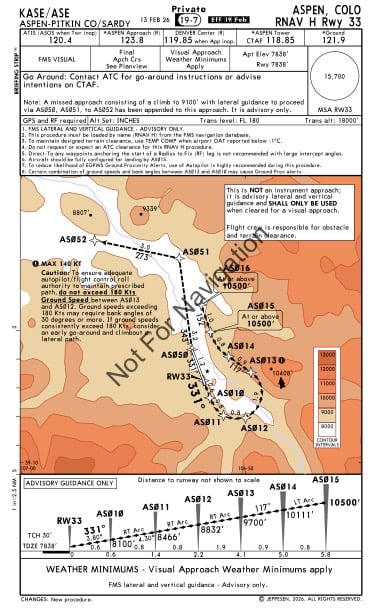
Honeywell designers had to go back to the drawing board a few times to get the Aspen Runway 33 FGV to work, where the ground proximity warning system wouldn’t keep alerting due to nearby terrain. This resulted in the turn from downwind to base being tighter, followed by a shallower base-to-final turn, essentially two different RF legs, according to senior technical sales manager Carey Miller. “We tested it, and we didn’t want to exceed 25 degrees bank. We designed it at least three times.”
Another factor that had to be considered was that during simulator testing, pilots were getting too many sink rate callouts on final because they were switching off the autopilot to try to land as close to the 1,000-foot displaced threshold as possible. Typical approaches have a threshold crossing height of 50 feet, but designers of this FGV were able to lower that slightly, eliminating the sink rate problem.
Further testing ensured that the approach works in a variety of wind conditions, including high groundspeeds. A note on the procedure advises not to exceed a groundspeed of 180 knots, otherwise steeper bank angles of 30 degrees would be required. Another note recommends fully configuring the airplane (landing gear and flaps) at the beginning of the downwind leg. If it becomes necessary to go around, the FGV guides airplanes along a path similar to the Cozy One VFR departure procedure.
This FGV approach, as are all of Honeywell’s FGVs, is a visual approach only, and Honeywell reminds users in another note that “This is not an instrument approach; it is advisory lateral and vertical guidance and shall only be used when cleared for a visual approach. Flight crew is responsible for obstacle and terrain clearance.”