Click Here to View This Page on Production Frontend
Click Here to Export Node Content
Click Here to View Printer-Friendly Version (Raw Backend)
Note: front-end display has links to styled print versions.
Content Node ID: 433464
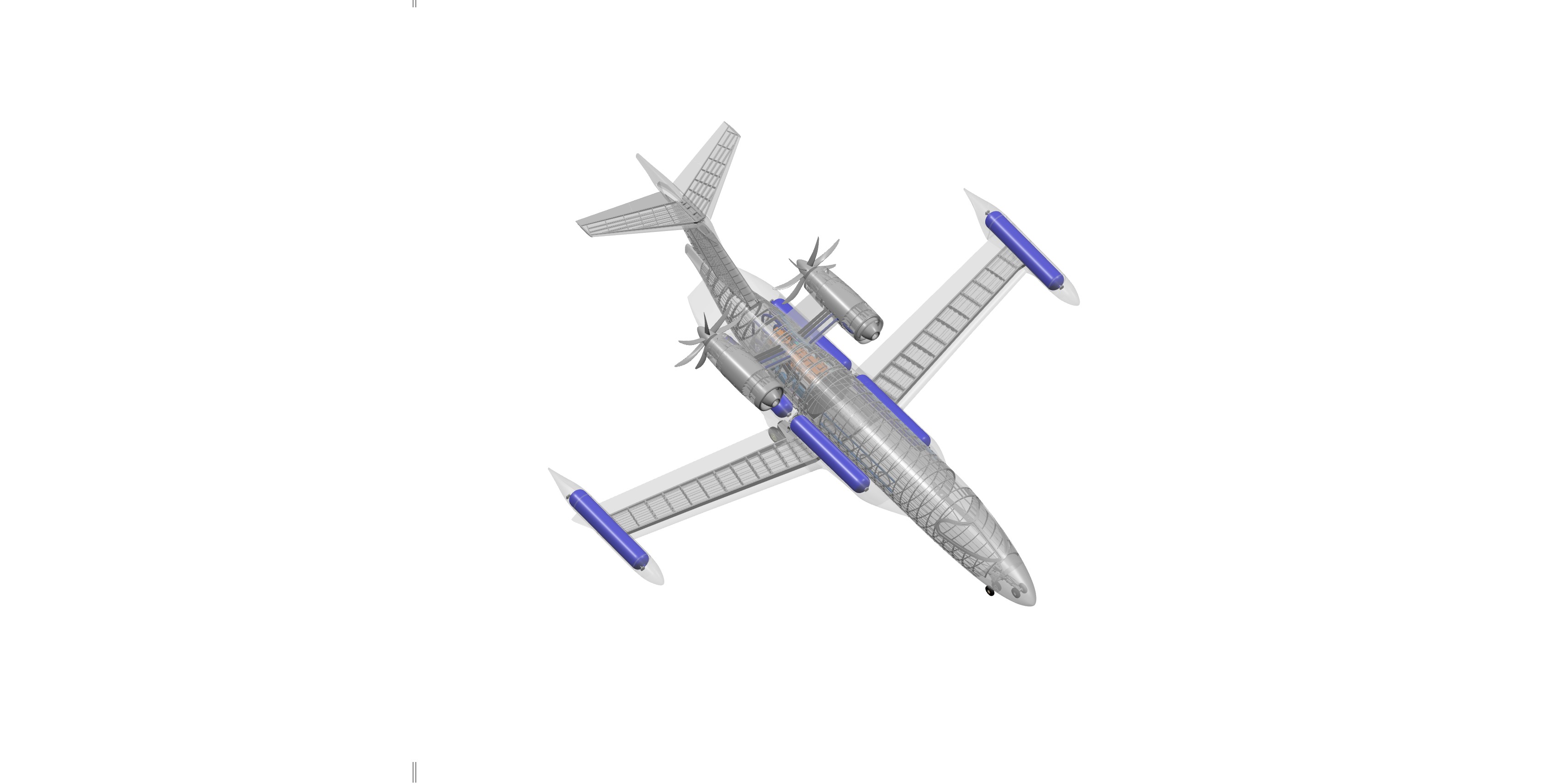
Rear-facing propfans have replaced the earlier ducted fan engines in the updated design for Beyond Aero’s in-development hydrogen-electric business airplane. On Tuesday, the French start-up released new drawings when it announced the completion of the preliminary design review for the eight-seat model.
The other significant change to the design is an increase in maximum takeoff weight from 8.6 to 9.6 metric tons (21,164 pounds). This means that the BYA-1 will need to be certified under EASA’s CS-25 rules, as opposed to the CS-23 rules for twin-engined commuter aircraft weighing less than 19,000 pounds.
Beyond Aero did not explain the reasons for the design changes but said that it has now finalized the architecture that will combine hydrogen storage tanks, a fuel cell-based electric propulsion system, and thermal management. Its Toulouse-based team of 80 engineers has now started work on detailed design as they work towards a certification plan with the European regulator.
The tail-mounted pusher propfans will run on gaseous hydrogen, starting at 700 bar, in externally mounted tanks on top of the BYA-1’s wingtips. According to Beyond Aero, this configuration enables natural ventilation and will facilitate refueling processes at airports, “while avoiding the added complexity of cryogenic liquid storage for early entry into service.”
In January, Beyond Aero completed the first wind tunnel tests using a one-eighth-scale model at the German-Dutch Wing Tunnels Low-Speed Facility at Marknesse in the Netherlands. These tests validated previously announced design changes, such as increasing the fuel cell stack capacity to 2.4 megawatts.
Beyond Aero has previously flown a subscale prototype with an 85-kilowatt propulsion system, and it has demonstrated 1,200-kilowatt capacity in ground tests so far. In October 2025, it acquired some of the intellectual property of U.S. start-up Universal Hydrogen, which folded in 2024.
“The preliminary design review confirms that the aircraft configuration and its major systems—propulsion, hydrogen storage, aerodynamics, and avionics—have reached the level of maturity required to support a certifiable architecture,” commented Beyond Aero chief engineer Luiz Oliveira, who was formerly with Embraer. “With this milestone completed, the program moves on schedule into detailed design and verification of the aircraft’s integrated systems.”
Beyond Aero is working on the second phase of its application for design organization approval in a process it started in April 2024 and its head of certification, Walter Filho, was formerly with Airbus. In December, it released plans for a factory where it intends to build the BYA-1, for which it says it holds letters of intent from prospective customers valued at more than $1 billion.
Carrying six passengers, Beyond Aero says that the BYA-1 will have a range of up to 800 nm with a cruise speed of 300 knots. The company is aiming to complete type certification and start deliveries before the end of 2030.
Program partners include fuel cell specialist FEV Aerospace, BrightLoop Converters, and Ekpo Fuel Cell Technologies, which has provided its NM20 energy conversion platform. It has also had some support for safety analysis and certification services from the Airbus Protect unit.