Click Here to View This Page on Production Frontend
Click Here to Export Node Content
Click Here to View Printer-Friendly Version (Raw Backend)
Note: front-end display has links to styled print versions.
Content Node ID: 434718
AMAC Aerospace’s significant investment in its aircraft-on-ground (AOG) response capability appears to have been validated by the service it provides to operators of Dassault Falcon jets. As an authorized service center for the French manufacturer, the company’s maintenance, repair, and overhaul facility in Istanbul, Turkey, now deals with at least two or three incidents each month, but has been known to launch two responses on the same day.
Dassault’s agreement with AMAC requires it to be able to have its AOG “GoTeam” respond within two hours of an operator requesting help. Within this time, it has to be able to give the clients details of the support plan and when technicians will get to the grounded aircraft, so that the operator has reassurance as to when they will be flying again.
“For a quick and proper AOG response, a very dedicated, highly experienced team is essential to analyze all the inputs and provide an effective plan to support the case,” Remzi Ozturk, AMAC Aerospace Turkey’s sales and key account director, told AIN. “AOG support is one of our core services, and thanks to our experts, we are always prepared to respond immediately. The team’s vast experience enables us to save time even in the initial stages of AOG support. They quickly determine what is wrong, how many technicians are needed, and what parts and tools are required to start the process promptly.”
Each AOG response will vary according to the approval level required for any specific repair work, the aircraft type, its registration, and current location, as well as the availability of resources. Sometimes, the GoTeam might load parts and supplies to drive to the location, or it may have to have the hardware flown out, which can be complicated if it involves dangerous goods.
“In some cases, we, as the service center, may have the necessary approvals for support input, but the customer’s aircraft may not, perhaps due to its registry,” Ozturk explained. “If approvals are missing, this must be applied for first before we can continue the process. If everything is in place, however, materials and technicians must go to the location.”
GoTeams Ready To Launch
The GoTeams can get sent almost anywhere at short notice. For instance, earlier this year, technicians were dispatched to help a Falcon 900EX EASy grounded in Erbil, Iraq, and in 2025, the company shipped parts for more than 150 AOG situations. The personnel have to ensure that they have all necessary travel permits up to date to be able to deploy instantly.
When AMAC’s specialists have to work in a location where there is no hangar, they operate using a mobile AOG toolbox with a tablet device and a laptop. Generally, they are guided by detailed instructions in fault isolation and other manuals provided by OEMs.
“If the fault is not known, these cases are reported to the manufacturer, who will make recommendations based on the type and nature of the failure,” Ozturk said.
In some locations, AMAC’s teams have had to be very creative in establishing an environment in which they can get a customer airborne quickly. A prime example was when an AMAC client had an AOG situation at Antalya in southern Turkey.
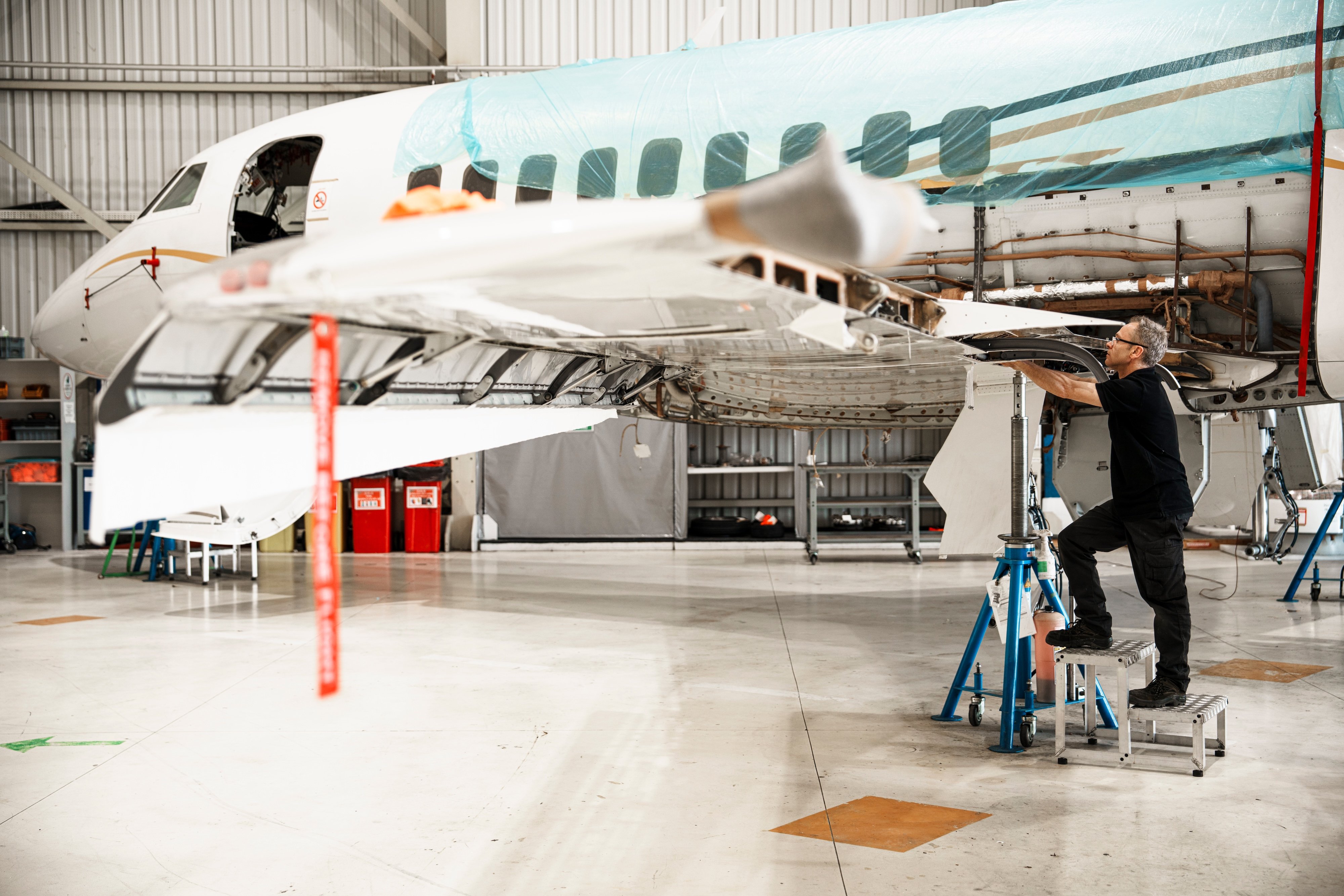
“The aircraft required support that could only be performed in a hangar, but there was no hangar available,” Ozturk explained. “Therefore, we created our own temporary hangar by renting an exhibition tent, which also had to be approved by the local authorities. It was a difficult process, but we managed to obtain approval and repair the aircraft so that it could resume operation.”
AMAC’s role in supporting Falcon jet operators keeps its MRO teams busy. For example, a long-term customer recently sent a 7X model to Istanbul for 800- and 1,600-hour inspections on each of its engines. During the work, the technicians resolved rattling noises from the engine igniter plugs and also from the APU, as well as upgrading electric power systems and working on crew seats, flight control systems, and brakes.
The group’s main maintenance, repair, and overhaul facility is located in Basel, Switzerland. It supports a wide range of business aircraft types including models produced by Gulfstream, Bombardier, Pilatus, Airbus, and Boeing.
In recent weeks, the Basel facility has performed work including checks on an ACJ 318, and ACJ 319 and an ACJ 330. The ACJ 318 was found to have fuel tank corrosion that needed to be rectified, and other work included changing out a halon-based fire extinguisher and window shade restoration.