Click Here to View This Page on Production Frontend
Click Here to Export Node Content
Click Here to View Printer-Friendly Version (Raw Backend)
Note: front-end display has links to styled print versions.
Content Node ID: 433544
Flight training organizations looking to improve the effectiveness of debriefing sessions are exploring how artificial intelligence (AI) can help. California-based start-up Navi AI is now trialing the use of a generative AI system that it says will help flight instructors and their students focus on all important points from training flights.
Embry-Riddle Aeronautical University and Sling Pilot Academy have been using the technology since 2024, and Navi is also working with other colleges, including the University of North Dakota, Purdue, Utah State, and Delta State. It has launched a collaboration with the U.S. Air Force for T-38 jet trainers under a $1.27 million contract from the Department of Defense.
Navi reported that it has so far collected and processed data from around 100,000 flights. The platform gathers and analyzes inputs from cockpit audio, aircraft telemetry, and avionics, having already been integrated with Garmin flight decks.
The approach is not without precedent. Leading training providers CAE and FlightSafety have already incorporated AI into their full-flight simulators to gather safety data to use in various ways, including during post-training debriefs. Austria’s Axis Flight Simulation has introduced what it calls its AI Debriefing Station for business aircraft training programs.
According to Navi, student pilots only retain around half of what they experience during flying lessons, and the company has described debriefs as chaotic. “Debriefing after training flights can be overwhelming due to the amount of systems you have to manage, such as the radio, communicating with the tower, and overall task saturation,” Nikola Kostic, Navi’s co-founder and CEO, told AIN.
For now, the technology is installed in aircraft drawing around 80 time-stamped data points from Garmin avionics, including traffic and weather data, radio calls, and discussions between pilot and instructor. Navi says the AI is trained to piece all of the “unstructured data” together to provide a comprehensive synthesis of every aspect of the training session, making it easier for instructors to focus on performance that needs improving.
The company has not yet sought to integrate the technology with full flight simulators, but it believes this could be accomplished and has run tests on Boeing and Airbus devices. It is looking to expand its partnership with Garmin.
Measuring Pilot Performance
During its flight, the Navi system ingests cockpit audio and aircraft data to generate what the company says are actionable insights for the trainee pilots and their instructors. The company’s domain-specific large language model analyzes intent, behavior, and performance, and then aligns its outputs with the respective flight school’s training syllabus for the lesson or maneuver being taught.
“Once the aircraft lands, the AI starts processing the flight, and this is ready in around five minutes when the instructor gets an alert on an iPad or other device,” Kostic explained. “Students don’t get a lot of time with their instructor, and it’s expensive, so this can make a real difference.”
After each flight, students can watch a replay overlaid on a 3D map, and they and their instructors can verbally communicate with the AI system. The system provides answers based exclusively on what is in the training manuals.
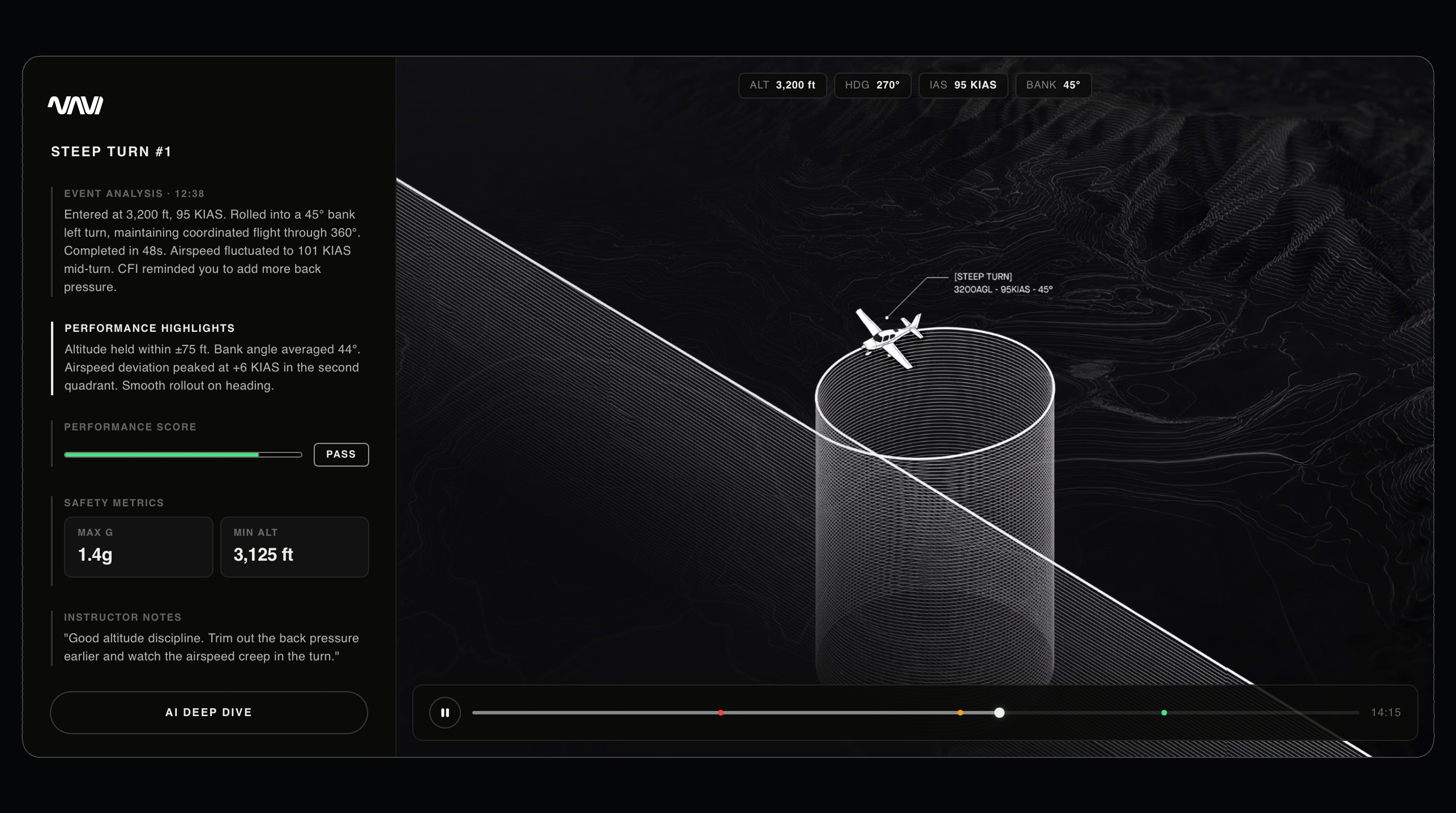
The interactive reports convey 40 to 50 key insights through text, visuals, and animations, offering an unprecedented phase-by-phase breakdown of every training flight from engine start to shutdown. Trainee pilots can also engage with an AI assistant trained to share standard operating procedures, FAA regulations, and flight-specific data, and can pose questions, pinpoint relevant citations, and get access to tutorials tied to their own performance.
“Navi AI is like a brain that knows which library to go to; it doesn’t just pull information from anywhere,” said Andrew Schneider, aviation professor, Embry-Riddle Daytona Beach. “In flight training, we don’t deal in approximation; we deal in precision. ‘Good enough’ isn’t good enough when you’re teaching stall recovery or crosswind technique. Navi AI triangulates from multiple data sources, avionics, audio, and ADS-B. That’s never been possible at this scale before.”
The company, which has raised $6 million in funding from investors including United Airlines Ventures, BVVC, New Vista Capital, Raptor Group, and ITBF, trains its AI to compare training events with each flight school’s standard operating procedures. According to Navi, the system compares what happened with what should have happened according to the training template and identifies points of divergence.
"Navi’s near-term focus is pilot training—equipping every training aircraft in the U.S. with its platform,” Kostic said. “Beyond training, the company plans to bring its AI to commercial aviation, applying the same real-time analysis and performance intelligence to airline operations, where the scale of data and the stakes of safety are exponentially greater.”