Click Here to View This Page on Production Frontend
Click Here to Export Node Content
Click Here to View Printer-Friendly Version (Raw Backend)
Note: front-end display has links to styled print versions.
Content Node ID: 399656
ACSS SafeRoute+ is the only current retrofit solution that enables airlines to take advantage of the time saving capabilities and flight efficiencies of ADS-B In technology, while making minimal investments in new avionics hardware.
According to the FAA, ATC typically handles 44,000 commercial flights per day, and the one thing the 2,789,000 passengers on those flights all have in common is, regardless of weather, they want to arrive at their destination on time.
Keeping all those flights on time throughout the NAS puts a lot of pressure on controllers and flight crews. That’s one of the reasons the FAA implemented the Automatic Dependent Surveillance-Broadcast (ADS-B) program. Aircraft equipped with ADS-B Out continually transmit their location, intention, speed, direction, and altitude in real-time, enabling controllers to better coordinate flow even during peak traffic times.
SafeRoute+ ADS-B In enhances situational awareness in the cockpit.
SafeRoute+ from ACSS brings all of the real-time situational awareness ADS-B benefits provides to ATC directly into the flight deck. And for aircraft already equipped with ACSS ADS-B Out, it’s a simple process and does not require the installation of EFBs. All it takes is a simple software upgrade to the existing TCAS 3000SP™ or T3CAS® computers, and the addition of the new ACSS ADS-B Guidance Display (AGD) to deliver unparalleled awareness of other aircraft within the broadcast area.
This creates an en route environment of shared traffic situational awareness between pilots and air traffic controllers.
According to Captain Dave Surridge, A320 captain and senior manager of optimization, policies and procedures for American Airlines, and a lead pilot in the carrier’s SafeRoute+ trail flights, while the system delivers exceptional situational awareness in all phases of flight, it’s most valuable during the critical approach phases of the flight.
“This new technology brings the same aircraft specific data that ATC uses into the flight deck, and that allows flight crews to get a more complete picture of what the ADS-B equipped aircraft around them are doing,” Captain Surridge said. “That bigger picture enables us to make better decisions about how the current stage of the flight is going to be conducted.”
“For example, if the pilots know how fast the aircraft ahead is traveling, compared to their own speed, they can make better decisions as to when to begin slowing down during the visual approach, or whether they can turn the corner sooner, or go straight, or turn towards the runway,” he said. “What we’re hoping to see is better spacing on final, better use of terminal airspace, and a reduction in go-arounds.”
Captain Surridge said that SafeRoute+ provides three capabilities to accomplish this type of efficient terminal spacing: CDTI-Assisted Visual Separation, Interval Management Spacing and In-Train Procedures.
CDTI-Assisted Visual Separation (CAVS)
By displaying the precise location and airspeed of the traffic ahead, SafeRoute+ CAVS enables crews to continue their approach with “visual approach accuracy” even in low visibility situations. Some studies have shown that CAVS has been able to reduce final approach time by as much as 14%, in addition to reducing go-arounds. This application will help keep airports running at full capacity, even during reduced visibility conditions.
Interval Management Spacing (IMS)
By providing accurate, time-based spacing between aircraft, IMS helps flight crews maintain consistent, well-spaced arrival flows to an airport. The benefits are reduced time flow, lower probability of vectors and go-arounds, and a reduction in aircraft inter-arrival spacing variance, resulting in enhanced block time predictability and the maximization of runway capacity.
In-Trail Procedures (ITP)
ITP provides flight crews with a vertical profile view of traffic over 100 nm away, which enables the crew to plan and execute climbs to more favorable altitudes when the aircraft is out of ATC radar coverage. The FAA has released studies that show transatlantic ITP-equipped aircraft saving an average of 670 pounds of fuel and transpacific flights realizing an average savings of 521 pounds of fuel.
Awareness in the air. Awareness on the ground.
While the in-flight benefits of ACSS SafeRoute+ are considerable, Captain Surridge stressed that the new-generation technology has shown to offer significant safety and traffic management advantages during ground operations.
Surface Area Movement Management (SAMM)
By providing a real-time moving map of equipped aircraft in the terminal, taxiway and runway areas, SAMM provides enhanced situational awareness for ground operations, which dramatically reduces the likelihood of runway incursions.
“It definitely has potential for helping improve ground operations and safety during taxi operations,” he said. “There is so much SafeRoute+ can do and we are just beginning to explore what all the benefits are.”
“We are currently working with the FAA to create new criteria that will allow advancements in avionics technology to benefit the national airspace system, the airlines and our customers,” Captain Surridge said. “In addition to our work with the FAA, we have talked to a lot of the air traffic controllers who have helped us during our initial flight tests and they are also excited to get the system operational on our aircraft.”
“They are looking for new ways that they can use this new technology to make their jobs more efficient,” he said. “Together, we are aiming to achieve increased efficiency and resiliency for our major hub operations.”
Because SafeRoute+ is a non-integrated solution, as these new capabilities are introduced, airlines will be able to migrate from basic to more advanced applications, while keeping costs specific to their operations.
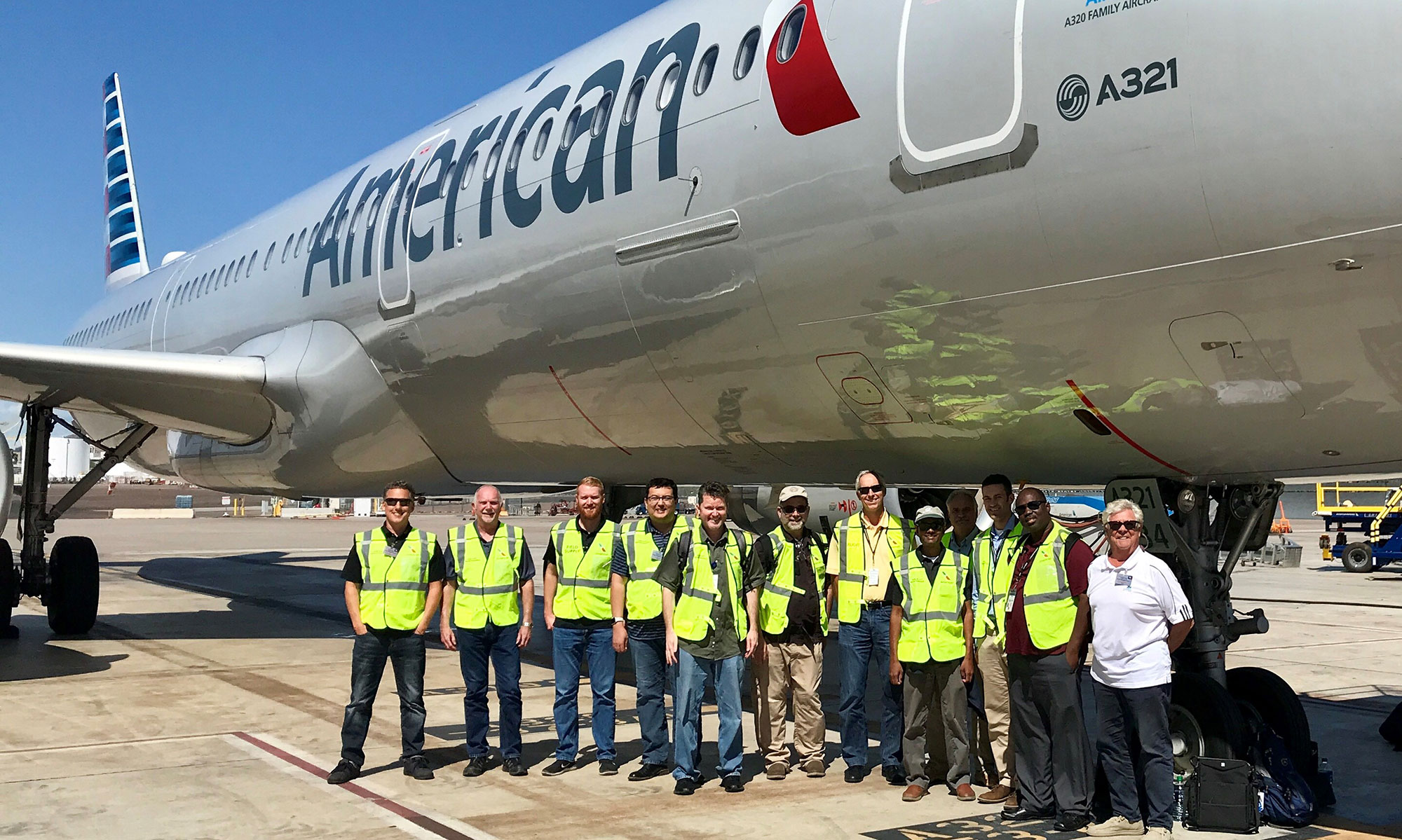
SafeRoute+ is simple to use.
Obviously, along with delivering advanced situational awareness capabilities, pilots want a system that is intuitive and easy to operate.
“Because the system uses existing navigational displays and MCDU’s, the good news on this front is there is minimal training required for flight crews to get the most out of SafeRoute+,” Captain Surridge said. “The system is very intuitive and easy to follow. Because we all are very familiar with the ACSS system and the TCAS displays, it’s a very simple transition to get familiar with the new ADS-B In displays.”
“American Airlines has had the system on our Airbus 330s for a while, and the training has proven to be minimal compared to the benefits that the system delivers,” he said. “From our experience, SafeRoute+ brings the greatest advancements in flight crew situational awareness to today’s aircraft with the smallest investment in aircraft upgrades.”